
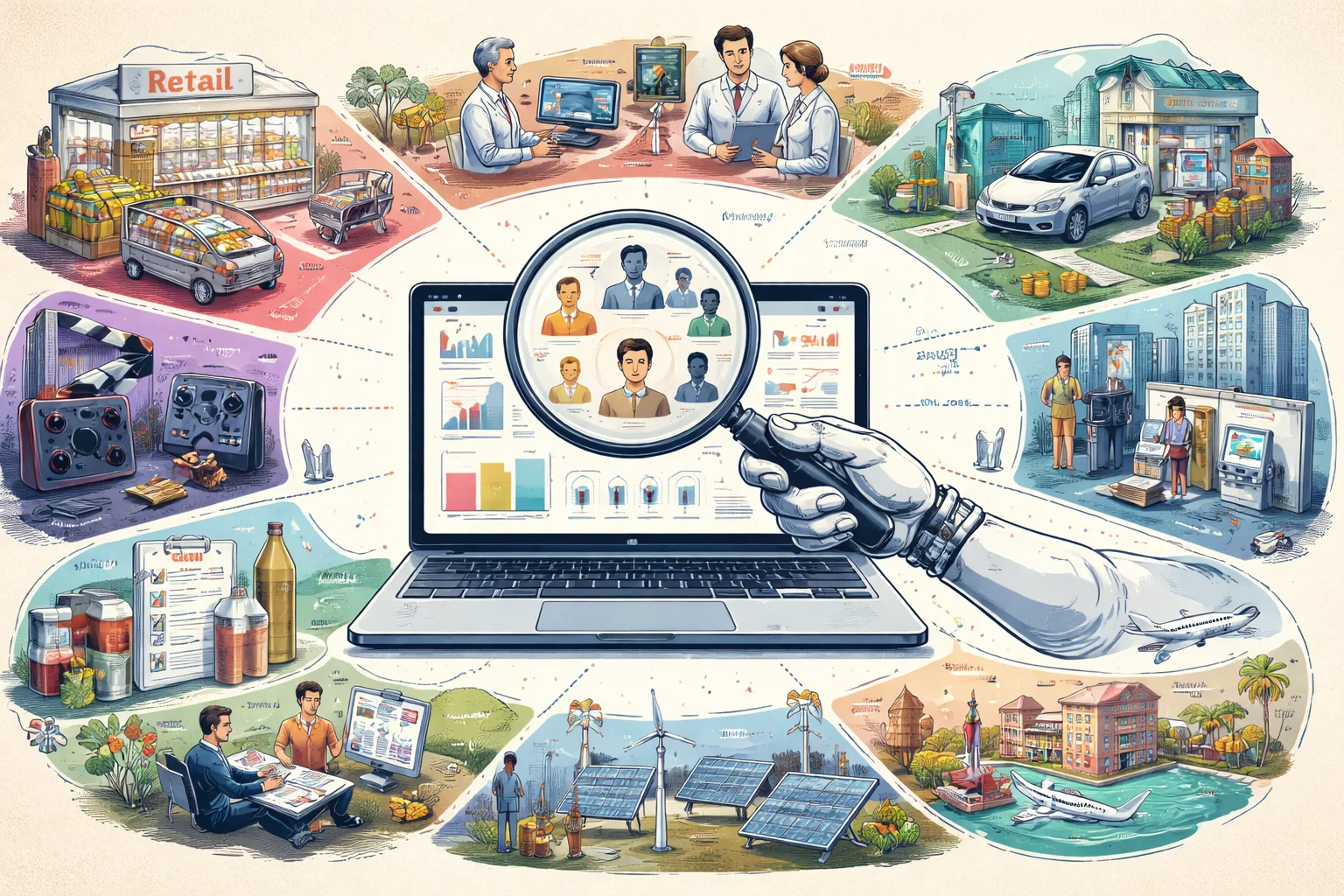
A list of industries that will be significantly impacted by synthetic market research
We explore which industries will be improved, impacted or fundamentally changed by Synthetic Market ResearchSynthetic market research turns “weeks of waiting” into “minutes of learning” by letting teams explore reactions, trade-offs, and segment differences before they spend real money (or political capital) on a decision. It does this by using "synthetic humans" - carefully created, calibrated and maintained simulations of humans. These synthetic humans can be used in realtime for market research, vastly speeding up the process of running market research reports, user studies, or getting product feedback.
The advantages of synthetic market research include:
Months to minutes - market research can be done significantly faster - typically 30-60mins for a 20-participant, 10-question survey
Ask Anyone, Anywhere, Anything - you can perform market research with literally anyone - our customers are talking to off-the-grid rural farmers, moms with newborns, high-powered lawyers, and Fortune 500 CEOs
Repeatable and consistent - you can easily revisit participants to pick up your research, dig deeper, or explore key points
Immediate actionable insights - you can day-trade on our research - the response are immediate, accurate and incredibly insightful
This means that the biggest impact tends to land where iteration speed, sample access, and decision risk matter most - but the ripple effects spread much wider than classic consumer research.
Here are some industries and professions that we believe will be improved, changed or disrupted by synthetic market research:
Market research & insights providers (MRX)
Impact: A chunk of “discovery” work moves from recruiting humans to simulating audiences first, then validating with targeted human studies. That changes how projects are scoped: you might run 30 concept screens overnight, then take the best two into real-world fieldwork rather than paying for 30 separate studies. Why significant: it restructures the economics of insights - less time spent assembling panels and more time spent interpreting results, designing experiments, and defending decisions. In practice, MRX firms will differentiate less by “access to respondents” and more by research craftsmanship: sampling logic, bias checks, triangulation, and decision frameworks. Think of it as shifting from “data collection” as the product to “decision confidence” as the product.
Example: pre-test 10 alternative brand narratives across 12 segments, then commission human qual only for the two narratives that consistently outperform.
Advertising, creative agencies & brand strategy
Impact: Agencies get a fast feedback loop on the parts that usually stay fuzzy until the campaign is already running: “Which line actually resonates?”, “Which visual cues signal premium vs cheap?”, “Who feels excluded by this tone?” Instead of a single big pre-test, teams can iterate weekly - swapping hooks, changing claim hierarchy, testing different degrees of humour, or exploring how messages land in different cultural contexts. Why significant: because creative work is often judged subjectively; synthetic research adds a repeatable, segment-aware layer of evidence without killing speed. It also improves collaboration: creatives can defend bold choices with insight rather than taste, and clients can approve faster when they see coherent patterns across audience types. Done well, it reduces “boardroom battles” and increases “market-informed bravery.”
Example: test two taglines and three opening frames for a video ad to identify which one drives trust vs hype perceptions.
Consumer packaged goods (food, beverage, household)
Impact: CPG teams can stress-test a product idea from multiple angles before ever printing packaging - flavour expectations, claim credibility, price thresholds, and “what shelf does it belong on?” The biggest win is breadth: you can explore niche segments (e.g., “high-protein snackers,” “clean-label sceptics,” “value-first parents”) without waiting for enough of them to show up in a panel. Why significant: CPG has long development cycles and a graveyard of line extensions that looked fine internally but failed at shelf. Synthetic research makes it easier to spot early warning signs (confusing proposition, wrong usage occasion, disbelief in benefits) when changing course is still cheap. It also enables more ambitious portfolio thinking - quickly simulating how a new SKU cannibalises existing ones or expands the category.
Example: run a rapid “pack + price + claim” matrix to find where “plant-based” reads as premium vs where it triggers scepticism.
Retail (grocery, big-box, specialty)
Impact: Retailers can simulate category choices as a system: assortment breadth, private label positioning, promotion mechanics, and the messaging that explains changes to shoppers. Synthetic research helps answer practical questions like “Will shoppers accept fewer options if we improve value?” or “Which categories are most sensitive to price-per-unit framing?” Why significant: retail is a game of small edges multiplied by huge scale - a modest uplift in conversion or basket size can be worth millions. It also reduces the risk of customer backlash when stores change layouts, delist beloved items, or adjust loyalty rules. And it makes experimentation more continuous: instead of one seasonal reset, you can run “micro-tests” of category narratives month by month.
Example: pre-test reaction to replacing three national brands with one premium private label alternative and a clearer “why we changed” message.
E-commerce & DTC
Impact: DTC teams can test landing pages, bundles, subscription offers, and objections at the speed they ship creative - not at the speed they recruit research participants. Synthetic personas are especially useful for diagnosing why something fails: is it trust, confusion, perceived value, or mismatch with the shopper’s identity? Why significant: online businesses win by iteration velocity and message-market fit; synthetic research turns research into a daily habit rather than a quarterly project. It also lowers the cost of exploring “weird” ideas that might become breakthroughs - new positioning, unusual bundles, or a counter-intuitive price point. The result is fewer expensive A/B tests that burn traffic and more targeted experiments that start with a good hypothesis.
Example: test whether “free shipping” beats “10% off” for a sceptical segment, and whether either changes perceived quality.
Tech products & SaaS
Impact: Product teams can pressure-test onboarding flows, feature prioritisation, and value propositions before writing months of code. Instead of asking users “Would you use this?”, teams can explore scenario-driven questions: “If your boss asked for X tomorrow, what would you try?”, “What would make you switch tools?” Why significant: software decisions happen weekly; waiting weeks for research introduces a structural lag that competitors exploit. Synthetic research also helps with segmentation beyond job titles - different risk tolerances, procurement mindsets, and “DIY vs done-for-you” preferences. It won’t replace usability testing, but it can drastically improve which usability tests you run and what you expect to learn from them.
Example: simulate reactions to three pricing pages to find which one triggers “hidden fees” suspicion for finance stakeholders.
Gaming & interactive entertainment
Impact: Studios can explore how different player archetypes perceive progression, fairness, monetisation, and social status mechanics long before a feature hits live servers. Synthetic research is great for “backlash forecasting”: identifying which design choices feel predatory vs acceptable and which communications calm the community. Why significant: live-service economics are fragile - a single poorly handled update can spike churn and tank lifetime value. It also helps teams iterate on narrative hooks and genre positioning without relying entirely on gut feel or a small internal fan club. Over time, this creates more intentional game economies - and fewer “we didn’t think players would react like that” moments.
Example: test whether a new battle pass frame is perceived as “rewarding” or “grindy,” and which messages soften the grind perception.
Media, streaming & publishing
Impact: Content teams can screen premises, titles, trailers, cover art, and pricing bundles across different audience identities and viewing contexts. Synthetic research helps answer the awkward questions: “Is this interesting, or just interesting to us?”, “Does this feel derivative?”, “Who thinks this is for them?” Why significant: content bets are capital intensive and the feedback loop is slow - you don’t find out you were wrong until after release. It also improves catalog strategy: exploring which combinations of content and pricing reduce churn for different subscriber personas. Used thoughtfully, it can reduce the number of safe, bland decisions - because risk can be explored before it’s irreversibly committed.
Example: test two trailer cuts to see which one signals “prestige drama” vs “soap,” and how that changes intent-to-watch.
Financial services (banking, cards, fintech)
Impact: Financial brands can test trust signals, fee framing, and product comprehension with different risk profiles and levels of financial literacy. Synthetic research also enables scenario simulation: how do people react to rate changes, tighter credit, or new fraud controls - and what messaging preserves trust? Why significant: experimentation is expensive and mistakes are amplified - confusion becomes complaints, and distrust becomes attrition. It’s also a rare place where clarity is a competitive advantage; the brand that explains best often wins, even if the product is similar. Done well, synthetic research reduces the likelihood of launching “fine print” products that feel like traps to customers.
Example: test whether “0% for 12 months” is understood as a genuine offer or a hidden-debt trap, and which disclaimers improve confidence.
Insurance
Impact: Insurers can rapidly test whether people understand coverage, exclusions, deductibles, and claims processes - especially for complex products like cyber, pet, or travel. Synthetic personas can reveal which words cause misunderstanding (“excess,” “replacement cost,” “pre-existing”) and which explanations actually help. Why significant: many disputes start as comprehension failures, not malicious intent - and those failures are costly in churn and reputation. It also improves acquisition: when products are clearer, customers feel safer and conversion improves. Over time, better understanding can reduce claim friction and “surprise” moments that trigger negative reviews.
Example: compare three claim-status update styles to see which one reduces anxiety and prevents call-centre spikes.
Healthcare providers & payers
Impact: Providers and payers can explore patient journeys - appointment scheduling, pre-op instructions, billing communications, chronic care adherence - and find where people drop off. Synthetic personas make it easier to explore sensitive or hard-to-recruit experiences (e.g., navigating mental health services or complex diagnoses) before running real-world studies. Why significant: access and trust are huge, and human research can be slow, expensive, and ethically complex. Synthetic research can’t replace real patients, but it can shrink the hypothesis space so real patient time is used more respectfully and efficiently. The biggest value is often in language: finding which explanations reduce fear, confusion, and perceived stigma.
Example: test whether a new “plain language” bill format reduces the perception of surprise costs and improves payment completion.
Pharma & biotech
Impact: Teams can explore early HCP and patient perceptions of mechanism-of-action messaging, benefit-risk trade-offs, adherence barriers, and trial participation friction. Synthetic research can also stress-test launch narratives across countries and segments - not just “does it persuade?” but “does it trigger scepticism?” Why significant: launch decisions are high-stakes, regulated, and global; learning late is extremely costly. It supports better trial design too: testing which incentives feel ethical, which messages feel coercive, and which channels feel trustworthy. In the best cases, it reduces the number of “scientifically accurate but emotionally ineffective” communications.
Example: test patient-friendly benefit language vs technical language to see which one improves comprehension without inflating expectations.
Automotive & mobility (OEMs, EV, micromobility, ride-hail)
Impact: Mobility teams can simulate how people trade off price, range, safety, charging convenience, subscriptions, and brand trust - across very different lifestyles. For EVs, synthetic research is especially powerful for “range anxiety” and charging narratives: what actually calms fears vs what sounds like marketing spin? Why significant: product cycles are long and capital heavy; the earlier you learn, the cheaper it is to adjust. It also helps forecast adoption barriers in specific contexts (urban apartment dwellers vs suburban families vs rural commuters). This enables smarter go-to-market: not just which car to build, but which story to tell and which objections to pre-empt.
Example: test whether “80% charge in 20 minutes” is meaningful or misleading depending on drivers’ daily routines.
Travel, airlines, hotels & OTAs
Impact: Travel brands can test pricing transparency, loyalty programme changes, cancellation policies, and disruption communications (delays, strikes, weather). Synthetic research helps reveal which policies feel fair vs predatory and which messages preserve goodwill when things go wrong. Why significant: demand is volatile and reputational hits are expensive - customers don’t just churn, they warn friends. It also helps tailor experiences: business travellers, families, and budget explorers react to “value” cues in very different ways. Better messaging and policy design can reduce support load while improving repeat bookings.
Example: test three cancellation-policy explanations to minimise the “gotcha” feeling while still protecting revenue.
Real estate & proptech
Impact: Teams can explore what “value” means in different micro-markets: amenities, commute time, school zones, safety perceptions, and community identity. Synthetic research is useful for testing listing language and neighbourhood narratives - the subtle cues that signal “family-friendly,” “young professional,” or “quiet retreat.” Why significant: housing decisions are emotional and high-stakes, and small mismatches in expectation create big dissatisfaction. It also helps proptech products refine onboarding and trust - especially when users fear scams, hidden fees, or poor maintenance. Over time, it can make the market more transparent by revealing which information actually reduces uncertainty for different buyer/renter personas.
Example: test whether emphasising “near transit” helps or hurts depending on whether a segment associates transit with convenience or noise.
Telecom & connectivity
Impact: Telecoms can test plan architecture, bundle design, and the language that explains data caps, throttling, roaming, and upgrade rules. Synthetic personas are particularly good at surfacing “bill shock” triggers - the phrases and structures that customers interpret as traps. Why significant: churn is costly and driven as much by confusion and distrust as by network performance. Faster testing lets teams refine offers and communications before a bad plan rolls out nationally and floods support. In the long run, clearer plans become a brand advantage, not just a compliance checkbox.
Example: test whether “unlimited” messaging creates backlash when users discover fair-use limits, and which alternative wording maintains trust.
Energy & utilities
Impact: Utilities can rapidly test communications for rate changes, outage updates, demand-response programmes, and adoption of electrification tech (heat pumps, EV charging, smart thermostats). Synthetic research helps identify which incentives feel motivating vs insulting and which explanations reduce the “they’re blaming customers” reaction. Why significant: energy transitions require behaviour change at scale, and behaviour change fails when trust fails. It also improves equity outcomes: different households face different constraints, so “one message” rarely fits all. When utilities communicate better, they reduce complaint volume and increase participation in programmes that stabilise the grid.
Example: test which explanation makes time-of-use pricing feel like empowerment rather than punishment.
Education (edtech, universities, training)
Impact: Education providers can test how different learners interpret credential value, time commitment, employability claims, and financing options. Synthetic personas can reveal motivational differences: some learners respond to career outcomes, others to identity (“I’m becoming a designer”), others to community and accountability. Why significant: acquisition costs are high and churn can be brutal; messaging that attracts the wrong learner profile creates dropout. It also helps with product design: which supports reduce anxiety - mentor access, cohort structures, smaller milestones, or clearer feedback? Over time, programmes can be positioned with more honesty and precision, improving outcomes and reputation.
Example: test whether “job-ready in 12 weeks” is motivating or triggers scepticism depending on prior experience with online courses.
B2B industrials & manufacturing
Impact: B2B teams can refine ICPs, ROI narratives, and procurement objection handling by simulating different buying committees - operations, finance, IT, and safety. Synthetic research makes it easier to explore “hidden vetoes”: compliance concerns, integration anxiety, or fear of change management burden. Why significant: real-world B2B research often has tiny samples and heavy gatekeeping - you can’t easily interview 50 procurement directors on a whim. It also improves sales enablement: better talk tracks, better case study framing, and fewer generic decks. The biggest wins show up as shorter cycles and fewer deals lost to late-stage surprises.
Example: simulate how a CFO reacts to a payback model vs how an ops leader reacts to downtime-risk language - and align both in the same pitch.
Public sector & policy
Impact: Governments and NGOs can test communications for benefits uptake, public health campaigns, emergency alerts, and policy rollouts - especially where misunderstanding reduces compliance. Synthetic personas help explore how messages land across literacy levels, language backgrounds, and trust in institutions. Why significant: public policy mistakes are extremely costly: loss of trust, lower participation, and polarised backlash that can derail good programmes. It also enables “pre-mortems” on policy design: simulate which trade-offs feel fair and where people will look for loopholes. When paired with real-world validation, synthetic research can make policy communication calmer, clearer, and more humane.
Example: test whether a new benefits eligibility explanation feels accessible or patronising, and which version improves intent to apply.
Summary
Synthetic market research is reshaping how organisations learn by replacing slow, expensive “wait for the panel” cycles with fast, repeatable simulations of how different audience segments think, feel, and choose.
Instead of commissioning a single study and hoping it answers the right question, teams can explore dozens of hypotheses quickly - testing product concepts, pricing structures, messaging variants, and policy or service changes before committing real budget, time, or reputational risk. This doesn’t eliminate the need for human research; it changes where it sits in the workflow. Synthetic research becomes the high-velocity discovery engine, while human studies are used strategically for validation, nuance, and grounding the most critical decisions.
The biggest impact lands in industries where iteration speed and decision risk matter
The biggest impact lands in industries where iteration speed and decision risk matter: CPG and retail can stress-test innovations and assortment moves; agencies and DTC brands can refine creative and offers at the tempo of modern marketing; SaaS and tech teams can pressure-test value props and onboarding before months of build. Highly regulated or trust-sensitive sectors like finance, insurance, healthcare, and utilities gain a safer way to refine communications, reduce confusion, and anticipate backlash - while automotive, travel, media, and gaming can use scenario testing to avoid costly misreads of what customers will tolerate or love.
Across all of these industries, the significance is structural: research shifts from an occasional project to a continuous capability, making organisations faster to learn, better at targeting, and more confident when making high-stakes bets.