
The attention economy has a problem: the pie isn't getting bigger, but everyone's trying to serve more slices.
Attention is finite. People have 24 hours in a day, a limited capacity to care, and an upper bound on how much information they can process before it all blurs into noise. For years this didn't matter because content production was constrained by cost and skill. Creating video ads required cameras, editors, actors, and budgets. Writing persuasive copy required talent and time. The supply of content grew slowly enough that attention could keep up.
That constraint is disappearing.
The Content Glut Is Here
Within a year, AI-generated video and images will be indistinguishable from professionally produced work. The cost of creation will drop so low that producing a hundred variations of an ad campaign will cost less than producing a single version today. Text, image, and video content will flood every channel because the barrier to entry has collapsed.
But more content doesn't mean more attention. It means less attention per piece.
If attention stays constant and content volume increases 10 times, each piece gets one-tenth the attention. If content volume increases 100 times, plausible given how cheap AI generation is becoming, each piece competes for one percent of what it used to capture.
The first instinct is often to fight volume with more volume. Create more ads, post more frequently, produce more campaigns. But that's fighting for smaller slices of the same pie while spending more to do it. Spray-and-pray is dead.
The Evidence Is Already Here
The attention collapse is measurable on every major platform.
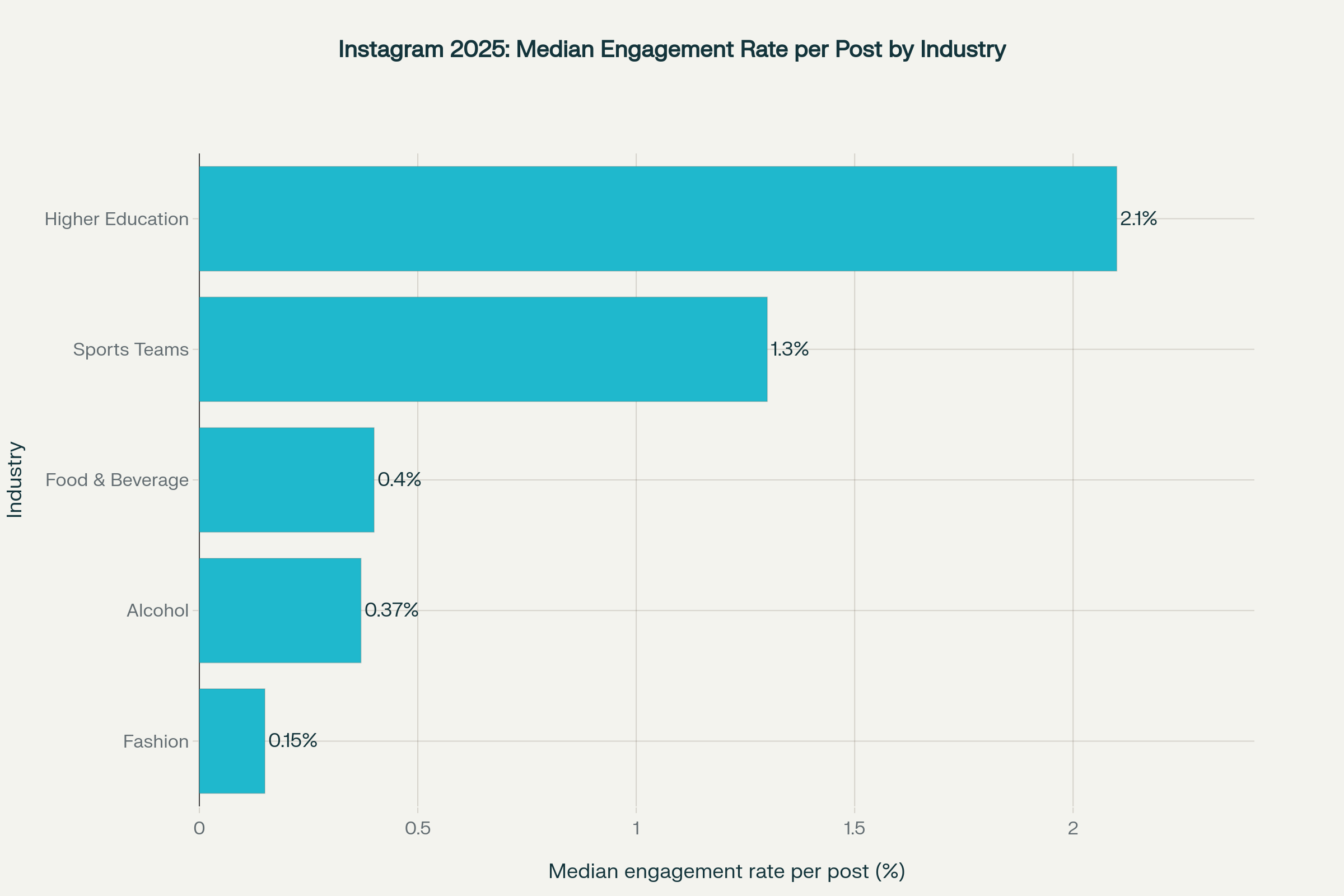
Instagram engagement rates fell from 1.22 percent to 0.47 percent between 2019 and 2022, a 61 percent decline in three years. By 2025, the trend accelerated further, with overall engagement dropping an additional 28 percent year over year.
The latest Rival IQ benchmark shows the collapse is hitting every platform. Year-over-year engagement rates dropped 36 percent on Facebook, 16 percent on Instagram, 34 percent on TikTok, and 48 percent on X.
The same content that would have generated meaningful interaction five years ago now disappears into the feed. Brands are posting more frequently than ever, yet reaching fewer people with less impact. The platforms are saturated, and the algorithms ruthlessly prioritize the tiny fraction of content that still captures attention.
Brands are throwing money at the problem. Social media advertising spending is projected to hit $276.7 billion in 2025, making it the largest channel worldwide by advertising investment.
But it's not working. A 2025 study by Taboola and Qualtrics found that 75 percent of performance marketers report diminishing returns on their social media ad spend. Over 30 percent say these declining returns are impacting a significant portion of their budgets, and more than half are now expanding into alternative digital channels like native advertising, programmatic display, and search ads because social isn't delivering.
When spending more money yields worse results, the economics collapse.
Precision Over Volume
If the solution isn't more content, what is it? Creating relevant content, and the only way to know what resonates is to test before you launch.
This is where synthetic research comes in. Instead of spraying campaigns into the market and hoping something resonates, you test messaging, creative, positioning, and tone against your exact target audience before spending a dollar on distribution. You learn what works in private, optimize in private, and only launch what you know will land.
At Ditto, our clients test LinkedIn posts, Instagram ads, product positioning, and campaign concepts against personas that model real human complexity—personality traits, media diets, contextual inputs, decision-making heuristics—and get directional feedback before the content goes live.
This isn't a focus group that takes three weeks to organize and gives you eight people's polite opinions in an artificial setting. This is rapid testing against hundreds of modeled consumers who respond based on how your message interacts with their psychological architecture and current context.
Be Wrong In Private
We built our Quick Questions option for exactly this problem.
Not every content decision requires a full research study. Sometimes you need to know: Does this ad resonate with our target demographic? Will this LinkedIn post land with decision-makers? Is this Instagram caption compelling or flat?
Quick Questions lets you A/B test content in minutes. Upload up to eight ad variations, select your target audience, and see which performs better and why. Test a social media post before it goes live. Validate a tagline before it locks into the campaign. Be wrong in private, iterate in private, launch with confidence.
While your competitors are testing in public, burning budget to see what sticks, you're testing in private and only launching winners. While they're trying to compensate for uncertainty with volume, you're using precision to cut through the noise.
Attention Is Finite, So Be Selective
The content glut is coming. The platforms will be saturated. The algorithms will prioritize ruthlessly. The audiences will tune out anything that doesn't immediately grab them.
You can respond by creating more content and hoping something breaks through, or you can create the right content and know it will break through before you hit publish.
The pie isn't getting bigger. Stop fighting for smaller slices. Start testing for bigger impact.