
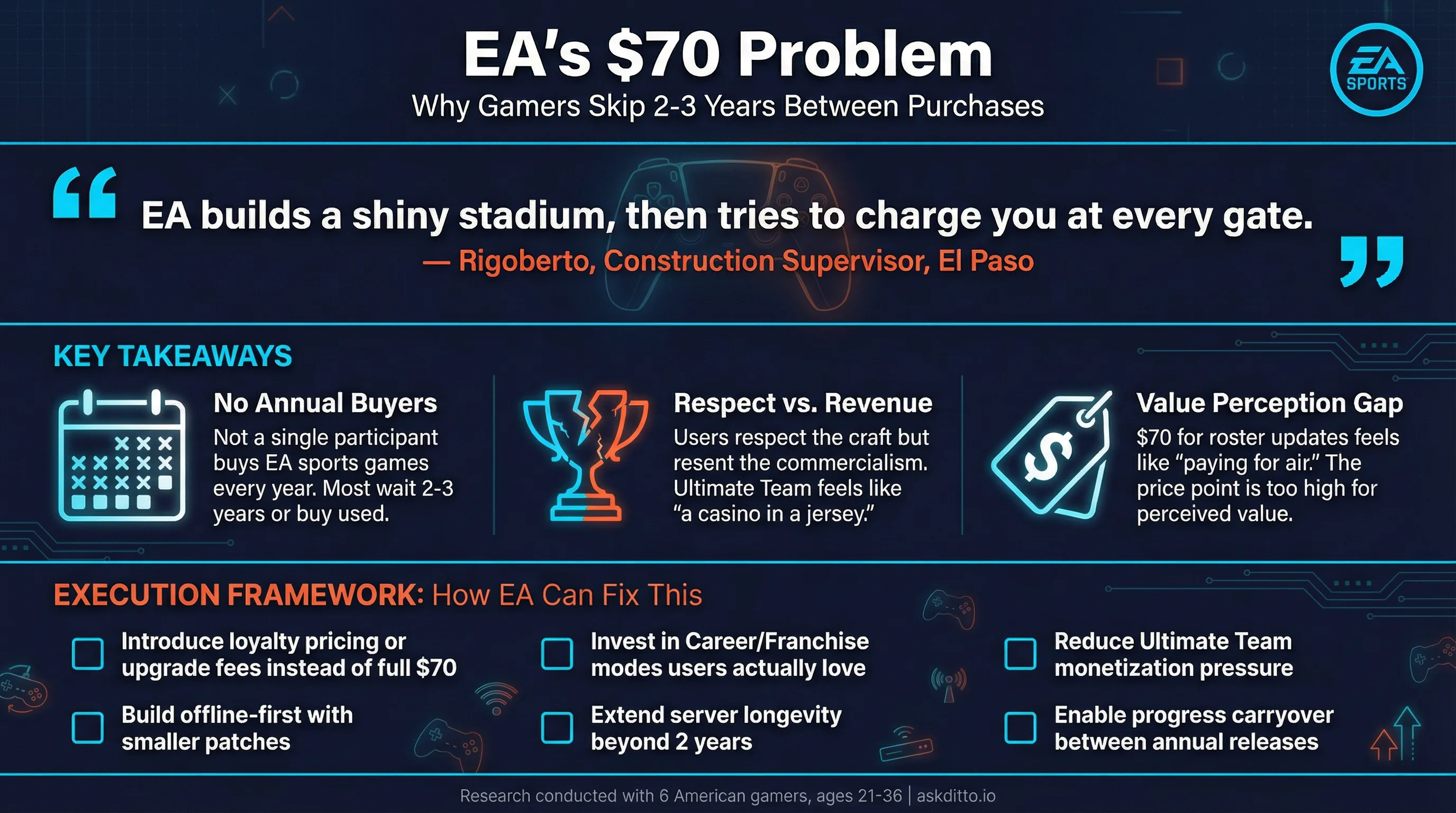
A casino in a jersey. That is how one participant described EA's Ultimate Team mode. Another called it "paying for air." A third said the annual release cycle felt like "a database patch" at full price.
I ran a study with 6 American gamers to understand how they really feel about EA Sports titles like Madden and EA FC (formerly FIFA). These are not casual observers. They are the core audience: sports game fans who grew up with these franchises.
The findings are damning. Not a single participant buys EA sports games every year. Most wait 2-3 years, buy used, or play on a friend's console. And the reason comes down to two words: respect and value.
The Participants
Six Americans, ages 21-36, from rural Pennsylvania, Glendale (AZ), El Paso, Baton Rouge, Quincy (MA), and Austin. Stay-at-home parents, maintenance technicians, construction managers, caregivers, and glass workers. All budget-conscious, all gamers, all deeply skeptical of EA's current approach.
What unites them: they love sports games but hate feeling nickel-and-dimed. They do cost-per-hour calculations. They keep games for years. And they have zero patience for store tabs in their face or features that feel gutted to sell back later.
What Comes to Mind When You Think of EA?
The responses fell into a clear pattern: respect for the craft, frustration with the business model.
When I hear EA, I think sports, big hype, and a store button in my face.
Jamal, a 36-year-old Austin glass worker, captured the duality. EA makes polished games with tight controls, great atmosphere, and the licenses that matter (Cruz Azul, Austin FC). But then the store appears everywhere, and the spell breaks.
What EA does well, according to participants: Polish and production values. Easy onboarding and tutorials. Stadium atmosphere and crowd noise. Core gameplay that feels right. Broad appeal across skill levels. Licenses and authentic team kits.
What frustrates them: Ultimate Team monetization ("feels like scratch-offs"). Annual releases that feel like roster updates. Menus that feel slow and heavy with pop-ups. Patches that change gameplay mid-season. Older titles abandoned quickly. Store tabs everywhere. Huge downloads and patches.
EA builds a shiny stadium, then tries to charge you at every gate.
Rigoberto, a 36-year-old El Paso construction supervisor, summarized the brand problem perfectly. The stadium metaphor resonated across multiple responses.
Key insight: EA's brand is defined by the gap between craft and commercialism. Users respect the games but resent the monetization.
The Line Between Acceptable and Exploitative
I asked participants where they draw the line on microtransactions, season passes, and in-game purchases in games they paid full price for.
The answers were remarkably consistent. The line is clear, and EA crosses it regularly.
If I paid full price, do not nickel-and-dime me inside the menus. Sell me a complete game.
Darren, a 24-year-old maintenance technician from Glendale who lives on a tight budget with mobile-only internet, laid out the rules that every participant echoed.
Acceptable to users: Cosmetic-only items at flat prices, no RNG. Real expansions that add maps, missions, or story months later. Free updates funded by optional skins. Content that stays with you permanently.
Exploitative to users: Pay-to-win or XP boosts that fix intentionally bad grind. Loot boxes and gacha mechanics. Battle passes with FOMO and expiring rewards. Funny money bundles that leave coins stranded. Day-one content that was clearly finished but held back. Store pop-ups every few minutes. Games tuned to push purchases.
If an app wants the keys to my checking, it has to beat my spreadsheet and not give me the ick.
Hannah, a 28-year-old stay-at-home mother from Baton Rouge, brought up the family angle. Her kids beg for packs and coins because the game is designed to create that pressure. She has to lock down purchases and still fields constant requests.
Key insight: Users are not anti-spending. They are anti-manipulation. Real value at fair prices? Fine. Psychological tricks to extract money? Instant brand damage.
Do You Buy EA Sports Games Every Year?
This is the question that should worry EA executives. The answer was unanimous: no.
Every single participant skips years between purchases. The typical pattern: buy every 2-3 years, wait for deep discounts, buy used, or play on a friend's console.
Full price yearly for a new roster feels like paying for air.
Heidi, a 31-year-old stay-at-home mother of five in rural Pennsylvania, captured the value perception problem. Her family plays last year's copy at a friend's house or grabs the used disc when it hits the clearance bin.
What would make users buy the next version:
Real upgrades they can feel in one night. Offline-first with small patches. Kid-safe toggles to turn off Ultimate Team. Progress carryover from last year. Loyalty pricing (upgrade fee instead of full price). Server longevity promise. Career/Franchise mode depth. Price under $40.
What pushes users away:
$70 price tag for marginal changes. Ultimate Team in your face everywhere. Early access locked behind subscriptions. Servers shut down after 2 years. Day-one bugs and forced online. Features yanked then sold back as "new." Huge installs and patches.
If it is just hype and Ultimate Team, I wait, I buy used, and I drink my cafecito in Career with Cruz Azul at night.
Jamal's approach represents a growing user segment: engaged fans who refuse to participate in the annual cycle or the monetization ecosystem. They play the modes that do not cost extra (Career, Franchise) and ignore the rest.
Key insight: EA has trained its most loyal customers to wait. The annual model is not working for users, and they are voting with delayed wallets.
What This Means for EA and Sports Gaming
The research points to a fundamental sustainability problem. EA has optimized for short-term monetization at the cost of long-term brand equity.
Actionable takeaways:
1. The $70 price point is too high for perceived value. Users see the same game with roster updates. Consider loyalty pricing, upgrade fees, or Game Pass-style models.
2. Career/Franchise mode is underinvested. The modes that do not generate MTX revenue are the modes users love most. Invest in them anyway.
3. Ultimate Team is actively pushing people away. The "casino in a jersey" perception is real and growing. The mode that drives revenue is damaging the brand.
4. Offline-first is a competitive advantage. Users hate huge downloads, day-one patches, and always-online requirements for single-player modes.
5. Server longevity matters. Shutting down servers after 2 years destroys perceived value. Users know their purchase has an expiration date.
6. Progress carryover could change buying patterns. If teams, sliders, and saves transferred between years, the upgrade calculation changes completely.
The Bottom Line
EA has a brand perception problem that better marketing cannot solve. Users respect the craft but resent the commercialism. They love the games but hate the business model.
The path forward is not more monetization features or better pack odds. It is a complete rethink of the value proposition. Career mode depth. Offline respect. Fair pricing. Progress carryover. And maybe most importantly, a store that knows when to stay quiet.
The gamers are doing the math. Right now, the math says: wait two years and buy used. EA should be asking what it would take to change that calculation.
Want to understand how your customers think? Ditto lets you run studies like this in hours. Book a demo at askditto.io.
What the Research Revealed
We asked gamers to share their thoughts. Here is what they told us:
What comes to mind when you think of EA as a gaming company?
Jamal Rosado, 36, Glass Worker, Austin, TX:
EA? I think sports, big hype, and a store button in my face. I still say FIFA, even if they changed the name. Feels slick, looks pretty, and then it tries to sell me stuff every screen. I only buy it used a year late or I play on my primo's console.
Darren Perez, 24, Maintenance Tech, Glendale, AZ:
When I hear EA, I picture two things: polish and nickel-and-diming. They do big set pieces well, tight controls, great sound, and when they actually commit to a single-player run, it's a solid weekend. What kills it for me is the live-service grind.
Rigoberto Delgado, 36, Construction Manager, El Paso, TX:
EA? I think slick licenses, TV-level presentation, and a whole lot of nickel-and-diming. They build a shiny stadium, then try to charge you at every gate. I'll grab a sports title every 2 or 3 years, stick to offline seasons when I can, and ignore the store.