
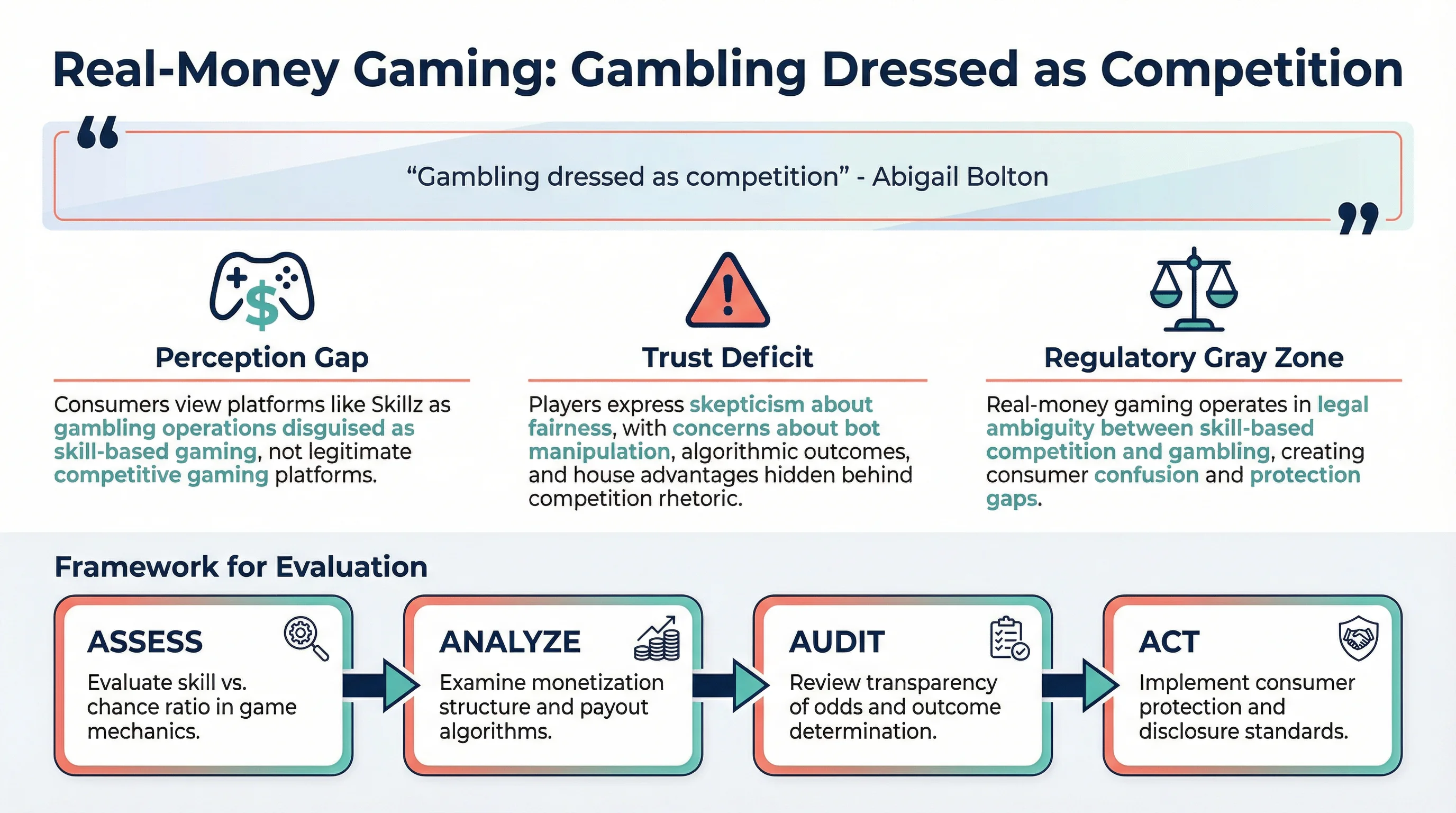
"Gambling dressed as competition." That was how Abigail Bolton described real-money mobile gaming when I ran a study with six American consumers. The consensus was stark: platforms like Skillz present gambling mechanics under a competition facade, and consumers see through it.
The key insight? Real-money gaming is perceived as "gambling masquerading as competition" and no amount of skill-based positioning changes that perception without radical transparency.
The Participants
Six mobile gamers from across the United States: a former fintech product manager in New Jersey, a healthcare administrator in rural Arkansas, an unemployed Michigan resident, a DHS administrator in Escondido, an insurance producer in Atlanta, and a retail sales worker in Jacksonville. Ages ranged from 27 to 42, incomes from zero to $168k. What united them? They all play mobile games and have strong opinions about where real money belongs.
The Gambling Perception Problem
I asked participants how they feel about real-money competition on casual games like Bingo and Dominoes. The response was unanimous: it feels like gambling, not skill-based gaming.
Abigail Bolton from Arkansas put it bluntly: "Slapping real money on bingo and dominoes feels less like friendly competition and more like gambling."
The concerns were consistent across all participants:
Predatory design mechanics - Elijah Arias observed: "It's built to keep you tapping, not to let you 'win and log off.'"
Fairness and bot doubts - universal scepticism about "no bots" and skill-based matchmaking claims
Opaque fees and rake - lack of transparency about house extraction
Cashout friction - concerns about withdrawal speed, KYC, and fund custody
Alon Macneil compared it unfavourably to traditional gaming: "Bingo at the parish hall... Not some app that takes a cut."
Key insight: Real-money casual gaming is categorised as gambling-first in consumer minds. The skill-based positioning is not credible without operational proof.
Do "No Bots" Claims Build Trust?
I tested whether claims of "no bots" and "skill-based matchmaking" would build confidence. They did not.
Generic claims lacked persuasive power without auditable evidence. Participants demanded verifiable proof, not marketing assurances:
Independent third-party audits - quarterly fairness and custody reports
Per-match transparency - opponent rating/region, timestamps, rake in dollars, replay access
Anti-bot verification - liveness metrics with public enforcement statistics
Provably fair randomness - verifiable random number generation
Key insight: Marketing claims about fairness are dismissed without third-party audits and operational transparency. "No bots" means nothing without proof.
What Would Make Deposits Acceptable?
I asked what safeguards would make participants comfortable depositing real money. The requirements were extensive:
Guaranteed fast cashouts - under 24 hours at the 95th percentile, with published SLAs and micro-withdrawal tests ($5)
Pre-deposit KYC - with minimal data collection, completed before first deposit
Segregated player funds - FBO custodial accounts with public attestation
Per-match rake display - fee shown in dollars before entry, not hidden percentages
Default responsible-play controls - hard loss/deposit caps, cool-off periods, self-exclusion, Family Mode
Ryan Costa from California was specific: "24-48 hours to card or ACH, no surprise 'reviews.' Miss it, you owe a credit or fee refund."
Danielle McCoy from Jacksonville spoke to the financial vulnerability angle: "My budget is tight and those apps feel predatory when you're chasing wins and watching fees nibble at you."
Key insight: Trust requires operational proof: fast guaranteed cashouts, segregated funds, per-match fee transparency, and default responsible-play controls.
Segment-Specific Concerns
Different segments had distinct priorities:
Lower-income users (Danielle McCoy) - high sensitivity to immediate financial harm. Demands hard spend controls, zero/transparent fees, and guaranteed withdrawal SLAs.
Rural/community-oriented users (Alon Macneil, Abigail Bolton) - prioritize simple visible signals (show opponent, replay, fee in dollars) and social proof that peers are getting paid.
Tech/fintech-educated users (Elijah Arias) - seek cryptographic/audit-grade evidence over marketing claims. Downloadable logs, verifiable metrics, public audit records.
Higher-income professionals (Rory Hollinger, Ryan Costa) - frame concerns in fiduciary terms. Request independent audits, published outcome distributions, SOC-level security.
Parents (Elijah Arias, Ryan Costa) - reject cash competition on role-modeling grounds. Prefer non-cash alternatives to avoid normalizing wagering.
Key insight: Concerns are universal but intensities vary. Lower-income users face highest immediate harm risk; parents face role-modeling concerns.
What This Means for Real-Money Gaming Platforms
If you are positioning a real-money gaming platform, here is what builds trust:
Display rake in dollars pre-entry. No hidden percentages. Show exactly what the house takes before the match starts.
Enable default loss/deposit caps with easy kill switch. Responsible play controls should be on by default, not buried in settings.
Publish cashout SLA and offer $5 micro-withdrawal test. Let users verify they can actually get money out before depositing more.
Remove dark patterns. No near-miss confetti, no pushy promos, no rematch nudges designed to extract deposits.
Launch transparency center with public dashboards. Player metrics, rake distributions, enforcement stats, quarterly audit reports.
The Bottom Line
Real-money casual gaming faces a fundamental perception problem: consumers categorise it as gambling, not skill-based competition. The "no bots" and "fair matching" claims are dismissed as marketing without operational proof.
As Elijah Arias put it: "It's built to keep you tapping, not to let you 'win and log off.'" That perception only changes with radical transparency: per-match fee disclosure, guaranteed fast cashouts, independent audits, and default responsible-play controls.
Want to test your own gaming platform positioning? Ditto lets you run studies like this in hours, not weeks. Book a demo at askditto.io.
What the Research Revealed
We asked real consumers to share their thoughts. Here is what they told us:
How do you feel about real-money competition on casual games like Bingo and Dominoes?
Abigail Bolton, 27, Healthcare Administrator, Rural AR, USA:
Slapping real money on bingo and dominoes feels less like friendly competition and more like gambling. The skill-based claim does not change that the house takes a cut and the mechanics are designed to keep you playing.
Elijah Arias, 34, Unemployed (ex-fintech PM), Edison, NJ, USA:
Sceptical. It is built to keep you tapping, not to let you win and log off. Near-misses, rematch nudges, streaks - these are engagement hooks disguised as competition.
Alon Macneil, 38, Unemployed, Rural MI, USA:
Bingo at the parish hall, sure. Not some app that takes a cut. Real money on casual games feels like gambling with extra steps to make it seem like skill.
Do claims of "no bots" and "skill-based matchmaking" build confidence?
Elijah Arias, 34, Unemployed (ex-fintech PM), Edison, NJ, USA:
No. Generic claims are noise. I need downloadable logs, verifiable metrics, public audit records. Show me the cryptographic proof or I assume the worst.
Ryan Costa, 42, DHS Administrator/Marine Vet, Escondido, CA, USA:
Not without proof. Independent third-party audits, per-match transparency showing opponent and rake, replay access. Marketing claims are meaningless.
Rory Hollinger, 28, Insurance Producer, Atlanta, GA, USA:
Claims mean nothing without SOC-level audits, published outcome distributions, and segregated player funds. I frame this in fiduciary terms. Show me the custodial attestation.
What safeguards would make you comfortable depositing real money?
Danielle McCoy, 33, Retail Sales, Jacksonville, FL, USA:
My budget is tight. Hard spend controls, zero or transparent fees, guaranteed withdrawal SLAs under 24 hours. If I cannot get money out fast, I do not put money in.
Ryan Costa, 42, DHS Administrator/Marine Vet, Escondido, CA, USA:
24-48 hours to card or ACH, no surprise reviews. Miss the SLA, you owe a credit or fee refund. Pre-deposit KYC so I know I can cash out before I fund.
Elijah Arias, 34, Unemployed (ex-fintech PM), Edison, NJ, USA:
Segregated FBO custodial accounts with public attestation. Per-match rake in dollars pre-entry. Quarterly independent fairness audits. Default responsible-play controls on.