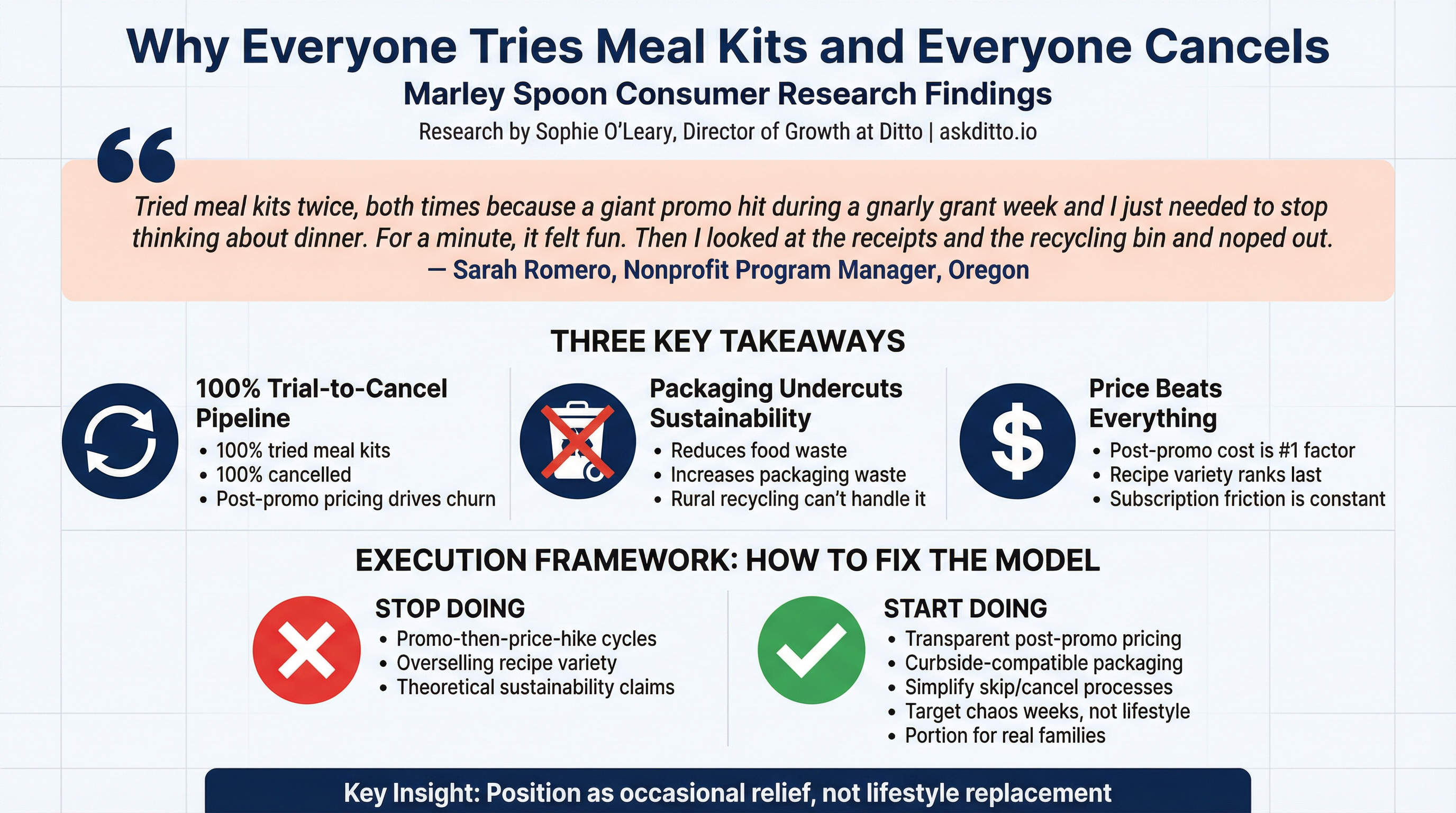
Here's something that keeps coming up in conversations about meal kits: everyone seems to have tried one, and almost everyone seems to have cancelled. When I asked six American consumers about their experience with meal kit services like Marley Spoon, HelloFresh, and Blue Apron, the pattern was strikingly consistent. They tried it. They saw the appeal. They hit the same walls. They left. And their reasons reveal fundamental tensions in the meal kit model that no amount of recipe innovation can solve.
I ran a study with six US consumers across different family situations and locations: a rural Wisconsin teacher, a telecom finance manager in Illinois, a nonprofit coordinator in Oregon, a construction manager in Tennessee, a stay-at-home mum in upstate New York, and an elementary school teacher in North Carolina. What unites them? They're all feeding families on real budgets with real time constraints.
The Participants
This was a pragmatic, budget-aware group. Ashley, 43, is a rural Wisconsin teacher and mum of two who values durability and community ties. Russell, 54, is a health-conscious finance manager in rural Illinois who mentors robotics teams. Sarah, 40, is a nonprofit coordinator in Salem, Oregon who e-bikes to work and cooks big pots of soup. Devin, 31, is a bilingual construction lead in rural Tennessee saving for land. Lamonica, 41, is a graduate-educated stay-at-home mum of two in upstate New York. And Russell, 44, is a Black Catholic teacher in Durham biking to work with a tight budget.
What they share: careful money management, real cooking skills, and limited patience for subscriptions that don't deliver on their promises.
The Trial-and-Cancel Cycle: Everyone's Been Here
I asked participants whether they'd tried meal kits before, and what made them keep using them or cancel. Every single participant had tried meal kits. Every single one had cancelled.
"Tried meal kits twice, both times because a giant promo hit during a gnarly grant week and I just needed to stop thinking about dinner. For a minute, it felt fun. Then I looked at the receipts and the recycling bin and noped out."
That's Sarah in Oregon. The pattern across participants was remarkably consistent:
Price: Intro deals work, then post-promo pricing feels silly compared to Aldi or the local grocer
Portions: Fine for light eaters, useless with hungry teenagers or spouses who want seconds
Packaging: A mountain of plastic and soggy cardboard, ice packs piling up like unwanted pets
Time claims: '25 minutes' turns into 45 with fussy steps and dishes piled up
Delivery issues: Boxes sitting in cold or heat, proteins tepid, greens wilted
Subscription friction: Skipping weeks feels like a trap, easy to miss cutoffs and get charged
Kid palates: Too fussy, too sweet, too many scallions the kids pick around
The consensus: meal kits work as a "pressure valve" for chaos weeks, but they're not a lifestyle. Most participants would accept a gift box during a hard week, but wouldn't subscribe again.
Key insight: The trial-to-cancel pipeline isn't about product quality. It's about post-promo pricing, packaging guilt, and the friction of subscription management.
Sustainability: Important But Not Worth a Premium
Marley Spoon emphasizes reducing food waste through pre-portioned ingredients. I asked how important sustainability is when choosing a meal kit, and whether participants would pay more for less packaging waste. The answer: it matters, but it's a tiebreaker, not a driver.
"Sustainability matters to me, but with meal kits the packaging is the sticking point. Pre-portioned cuts fridge waste, sure, but then I'm drowning in tiny sachets and gel bricks my rural recycling won't take."
That's Lamonica in upstate New York. The sustainability paradox emerged clearly: meal kits reduce food waste but increase packaging waste, and for rural consumers, that trade-off often feels like a net negative.
What would move the needle:
Curbside-compatible materials that actually work in their county
Returnable systems with real pickup, not theoretical mail-back
Fewer fiddly packets, larger format sauces
Third-party verification of actual waste reduction claims
Paper-based insulation, not gel packs they have to drain
The premium tolerance? About 5-10% more, if it's real and measurable. Beyond that, they'll go back to Aldi and the Instant Pot.
Key insight: 'Sustainable' meal kits that generate more packaging than a grocery run undercut their own message. Consumers see through the marketing.
Choosing Between Competitors: Price Is King
With services like HelloFresh, Blue Apron, and Marley Spoon competing, what would make participants choose one over another? The answer was unambiguous: price, specifically the total delivered cost after promo periods end.
"What problem are we solving? For me, meal kits are a short-term patch during crazy weeks, not a lifestyle. If I pick one, it's the one that hits these marks first: all-in price per serving after promos, kid-eatability, true 20-30 minutes and 1-2 pans, portions that actually feed four."
That's Ashley in Wisconsin. The priority stack across participants was consistent:
Total delivered cost per serving after promo (not the intro deal, the real price)
Easy skip/cancel without games or cutoff traps
Honest time claims that account for actual cooking, not marketing fantasy
Rural delivery reliability in extreme temperatures
Kid-compatible options without sugar-bomb sauces
Packaging sanity (recyclable where they actually live)
Portions that feed real families with leftovers for lunch
Recipe variety landed last. Nobody mentioned wanting more adventurous options. They want reliable execution of simple meals.
Key insight: Meal kits compete on logistics, not cuisine. Price, delivery, and subscription flexibility matter far more than recipe innovation.
What This Means for Meal Kit Brands
If you're building or marketing a meal kit service, this research suggests some clear directions:
Lead with post-promo pricing. Intro offers get trials. Transparent ongoing costs get retention.
Fix the packaging problem honestly. If your 'sustainable' box generates more waste than a grocery trip, don't lead with sustainability.
Solve the skip-week friction. Every participant mentioned subscription management as a pain point.
Respect the rural reality. Delivery windows, cold chain integrity, and insulation that works in extreme weather matter.
Target chaos weeks, not lifestyle conversion. Position as occasional relief, not daily replacement.
Portion honestly. Families need food for teenagers, not portions sized for Instagram.
Stop overselling recipe variety. Users want 6 reliable hits they can repeat, not constant novelty.
The Bottom Line
Meal kits solve a real problem: the exhausting 'what's for dinner' decision during busy weeks. But the current model, with its promo-then-price-hike cycle, subscription friction, and packaging guilt, burns through customer goodwill. Every participant had cancelled at least one service.
The verdict from these six consumers? They'd use a meal kit again for a genuinely chaotic week, probably on a promo, and they'd cancel again as soon as the chaos passes. Until the industry addresses post-promo pricing and packaging waste honestly, that trial-and-cancel cycle will continue.
What the Research Revealed
We asked real consumers to share their thoughts. Here's what they told us:
If you've tried meal kits before, what made you keep using them or cancel?
Ashley Copley, 43, Elementary School Teacher, Rural, WI, USA:
I tried meal kits twice and canceled both times. Price: After the promo, the per-serving cost felt silly for what showed up. Portions: Fine for two light eaters. Useless with a hungry spouse and a 14-year-old who wants seconds. Packaging: A mountain of plastic and soggy cardboard. Time claims: Still lots of chopping and pan juggling.
Sarah Romero, 40, Nonprofit Program Manager, Salem city, OR, USA:
Tried meal kits twice, both times because a giant promo hit during a gnarly grant week. For a minute, it felt fun - new sauces, fresh herbs, no 5 p.m. grocery sprint. Then I looked at the receipts and the recycling bin and noped out. Price vs my WinCo list did not pencil out, portions skimpy, way too many tiny plastic tubs.
Russell Brown, 44, Elementary School Teacher, Durham city, NC, USA:
We tried a couple meal kits during a crazy basketball season and kept it for maybe a month, then bailed. What worked: brain-off meal planning, new flavors, kids helped cook. Why we canceled: cost higher than Food Lion, no leftovers for lunches, packaging drove me nuts, sodium-heavy sauces, time creep.
Lamonica Burris, 41, Stay-at-Home Parent, Rural, NY, USA:
Tried a couple kits twice: newborn haze and then peak soccer September. Kept them for a month each, then canceled. They solved decision fatigue, but the rest grated. Why I bailed: too much packaging clutter, recipes took longer than promised, no leftovers, kids side-eyed the fancy sauces.
Russell Paunovic, 54, Financial Analyst, Rural, IL, USA:
I did two stints with meal kits, about 6 to 8 weeks each. They were fine as training wheels to break a dinner rut. But I canceled both times because the math and the friction annoyed me. Price per serving creeps after intro deals. Packaging waste is a mountain. Delivery risk out here in rural Illinois.
Devin David, 31, Construction Manager, Rural, TN, USA:
Tried a couple boxes on a promo. Canceled fast. Just didn't pencil out for me. Price: Per plate was high even with the discount. I can do arroz, pollo, y pimientos for half the cost. Portions: Small. After a 10-hour day I'm still hungry. Packaging: Mountains of plastic.
How important is sustainability when choosing a meal kit? Would you pay more for less waste?
Ashley Copley, 43, Elementary School Teacher, Rural, WI, USA:
Sustainability matters to me, but it is a tie-breaker, not the driver. Price per serving and time saved carry the load. The plastic, liners, and gel packs pile up. Our town recycling will not take most of that. Would I pay more? Maybe 5% if the box is mostly cardboard and I can set it all at the curb without playing chemist.
Sarah Romero, 40, Nonprofit Program Manager, Salem city, OR, USA:
I care about sustainability a lot, but I get prickly when a company trumpets it and then my tiny apartment is drowning in plastic film and gel packs. Yes, it matters when I choose, but it's not the top slot. I'll pay a small bump I barely feel. I will not pay a 'feel-good tax' for tiny sauce packets wrapped in more plastic.
Russell Paunovic, 54, Financial Analyst, Rural, IL, USA:
Sustainability matters, but it is a tiebreaker after taste, price per serving, and time saved. The packaging footprint overwhelmed whatever food waste savings we saw. Would I pay more? Maybe 5 to 8 percent if they can prove curbside-compatible materials in my county, reusable systems, third-party verification.
Russell Brown, 44, Elementary School Teacher, Durham city, NC, USA:
Sustainability matters to me, but it sits behind price, weeknight sanity, and whether my kids will actually eat it. The extra packaging bugs me. Would I pay more? A little - maybe $5 more per box or roughly 10% tops. But I still need decent portions and easy skip weeks.
Devin David, 31, Construction Manager, Rural, TN, USA:
Important, but not the first box I tick. Pre-portioned helps me not waste food when I'm cooking solo, but the pile of plastic and ice packs makes me grind my teeth. If two kits are equal on taste and price, I pick the one with less trash every time. Would I pay more? About 5 percent or a couple bucks a box.
Lamonica Burris, 41, Stay-at-Home Parent, Rural, NY, USA:
Sustainability matters to me, but with meal kits the packaging is the sticking point. I'd pay a small premium - 5 to 10 percent - if the service hit returnable systems with easy pickup, fewer fiddly packets, family-size portions, transparent numbers showing actual packaging weight reduced.
What would make you choose one meal kit service over another?
Ashley Copley, 43, Elementary School Teacher, Rural, WI, USA:
What problem are we solving? For me, meal kits are a short-term patch during crazy weeks, not a lifestyle. My order of importance: price and control first, then kid-eatability and time, then quality. Variety is last. I'd run a 4-week pilot and if it fails two boxes, I cancel.
Russell Paunovic, 54, Financial Analyst, Rural, IL, USA:
It's not a single lever. I'll pick the one that pencils out on total delivered cost, hits our doorstep intact in February and August, and doesn't make me wrestle an app just to skip a week. Delivered price, not promo. Skip control and cutoff windows. Cold chain to rural Illinois.
Sarah Romero, 40, Nonprofit Program Manager, Salem city, OR, USA:
I'd pick the one that respects my time, my budget, and my trash can. Real price after the promo and shipping. Actual 30 minutes. Packaging sanity. Produce quality. Portions plus leftovers. Salt and sugar restraint. Skip/cancel without games.
Devin David, 31, Construction Manager, Rural, TN, USA:
I'd pick the one that saves me real time without playing games on price. Price that sticks - final cost per serving after shipping and once the promo ends. Real 30-minute meals. Protein and portions for physical work. Flavor that hits - chiles, cumin, cilantro. Delivery that survives rural TN.
Lamonica Burris, 41, Stay-at-Home Parent, Rural, NY, USA:
Price gets me to try it; low-friction reliability keeps me. Total cost per dinner after the intro bait. Packaging and disposal. Rural delivery reliability. Time honesty. Kid-compatible without sugar-bomb sauces. Ingredient quality. Recipe curation.
Russell Brown, 44, Elementary School Teacher, Durham city, NC, USA:
I'd pick the box that makes real life easier, not cuter. Total cost I can trust after promos, shipping, and tax. Real 30 minutes not 45 with dishes piled up. Decent portion sizes for two adults, a hungry teen, and a 9-year-old. Reasonable sodium. Kid-friendly without being bland.
Want to understand how your target customers really feel about your product? Ditto lets you run studies like this in hours, not weeks.