
When we first started work on Ditto, it was clear to us from the very beginning that while we were building a software product based on solid scientific principles, we needed to make sure to add an element of art. Why? To capture the inherent messiness of the human condition, and to avoid the temptation to create clean, sterile data that doesn't capture the reality of the world we live in.
Messiness matters because traditional research operates under three polite fictions:
people tell the truth,
people know what they want
researchers can extract stable preferences if they ask the right questions in the right environment
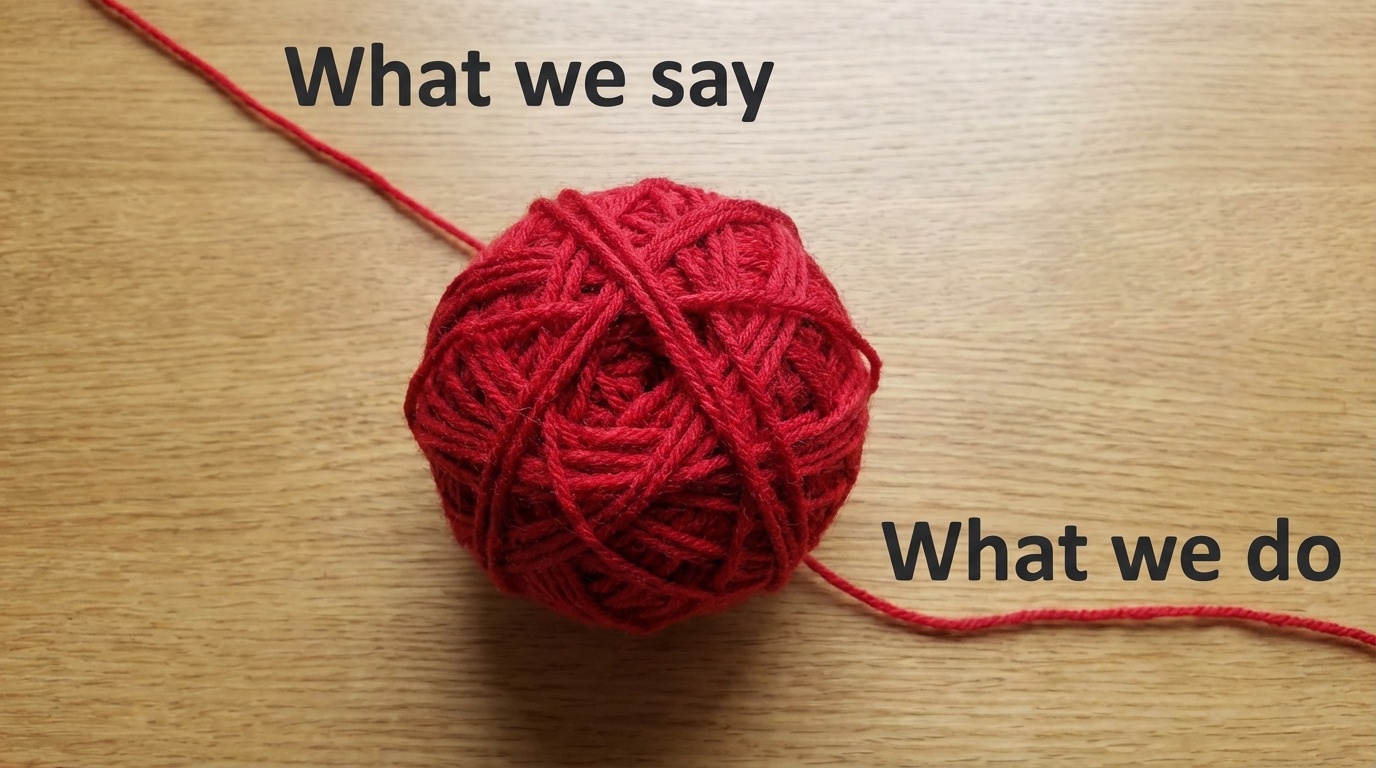
But the truth is that humans are not that clean-cut. We lie, we contradict ourselves, and we perform for the moderator, the group, or even our own self-image. Frequently, we say one thing and then immediately go and do another. The say-do gap describes a common issue where stated preferences often diverge wildly from actual purchasing behavior.
As a synthetic research company, we must capture this messiness to produce useful insights.
Our goal is not to make personas that are somehow more honest than humans, our goal is to make them more accurately human.
This means building personas on behavioral data, psychological architecture, and real-time contextual inputs, creating models that can be messier, and therefore more predictive, than traditional research that flattens human complexity into clean but misleading averages.
But humans aren't averages. Humans are bundles of contradictions that resolve differently depending on context.
So when you're investing in traditional research, you often walk away not knowing what people want, but what they want you to think they want.
Humans Don't Have Fixed Answers, Humans Have Variable Conditions
As humans, we don't have stable preferences waiting to be discovered. We have psychological conditions that produce different behaviors in different contexts.
Our personality architecture - the OCEAN traits of openness, conscientiousness, extraversion, agreeableness, and neuroticism - creates a baseline. Our emotional state shifts with the news, the weather, time of day, and even blood sugar. Whenever I am grumpy, my wife tells me to go and make a sandwich!
Recent information exposure also matters. What I read in an email or on social media this morning changes how I answer a question this afternoon. Decision-making heuristics and biases activate situationally. We communicate the same event differently to our parents, our spouse, or an old college friend. Social and economic context shifts the frame even further.
This leads to an interesting dilemma. The same person, on different days, gives a different answer to the same question, and both of these answers are true.
Ask someone in January if they'll travel internationally this summer. Now ask them again after a news cycle about airline delays, or after they've seen friends' vacation photos, or after their company announces layoffs.
The answer changes because the human changed.
How We Program Messiness: Our Synthetic Personas Layer Complexity Back In
Traditional surveys flatten human complexity, but our synthetic research can reconstruct it.
At Ditto, we build an architecture of messiness. But it's not enough to simply list personality traits and demographic data. The real power is in how these elements interact with each other. Information passes through psychological filters to produce emotional states that drive behavior.
Each of our personas starts with a fact-based demographic foundation that includes age, income, location, household composition, and education. Then we layer on a psychological profile using OCEAN personality traits that influence risk tolerance, decision speed, and social conformity.
We then add a media diet with weighted news sources that update every six hours, covering everything from politics to the weather to celebrity gossip. We then model how they process that information through their personality architecture to generate emotional responses. When a persona ingests news about an economic downturn, a high-neuroticism persona with budget constraints becomes anxious and risk-averse. A low-neuroticism persona with financial stability might see it as background noise. Same input, different filter, different emotional output.
Weather works the same way. A rainy Tuesday morning affects personas differently based on their personality and context. A high-openness urban persona might feel cozy and reflective, more willing to browse online and consider new products. A low-openness suburban persona with a long commute becomes irritable and postpones decisions. The weather is the same but the reaction is conditional.
We program in decision drivers and heuristics (budget constraints, brand loyalty, convenience prioritization, social proof sensitivity) that activate situationally. We model temporal emotional states so that recent experiences and information change what the persona feels and therefore how it responds. These filters stack and compound. It's not personality OR news OR weather. It's personality processing news in the context of weather while recent experiences are still resonating.
An example of how this works
Meet Sarah, a 42-year-old marketing director in Chicago. High conscientiousness, moderate neuroticism. Her media diet is weighted toward Wall Street Journal and NPR. On Monday morning, she ingests news about major retail bankruptcies. Her conscientiousness processes this as a signal to be cautious. Her media diet adds context about broader economic uncertainty. Her moderate neuroticism amplifies the concern slightly but doesn't trigger panic.
When we ask Sarah about trying a new premium snack product that Monday afternoon, she's hesitant. Her emotional state (cautious, slightly anxious) filters the question through a "now is not the time for discretionary spending" lens. She says no.
By Friday, Sarah has ingested positive jobs data. Her company announced strong quarterly results. The weather turned sunny after three gray days. Her neuroticism has settled. Her conscientiousness processes the new information as "conditions are stable." When we ask her the same question about the same premium snack product Friday afternoon, she's open to it. She describes it as a small treat after a good week.
Same persona. Same question. Different answer. Both answers are true because Sarah, like all humans, doesn't have a fixed preference waiting to be extracted. She has conditional responses that emerge from the interaction of personality, information, emotion, and context.
This is what we mean by programming messiness. We give each persona interests and values that filter how it interprets new information. We model the transformation layer, the mechanism by which events become emotional states that shape behavior. We update these states every six hours so that personas evolve as the world changes around them.
Why does building personas with more messiness produce better results than human research?
Because we're not asking humans to perform coherence they don't have. We're not averaging away contradictions, we're modeling the conditions under which contradictions resolve. We can rerun the same question under different emotional or informational conditions. The persona doesn't try to give you the right answer. It gives you the conditional answer and that’s where insight comes from.
The counterintuitive advantage is that synthetic research can be messier than human research because we're not constrained by respondent fatigue, social desirability, or the demand characteristics of the research setting.
Test the same product concept with the same persona cohort, but vary the news environment. How does response shift after economic uncertainty news? After category scandal news? After competitor launch news? Human research can't do this. Synthetic research can.
Messy Insights Are Better Insights
For category intelligence, messy insights let you predict not just what people prefer, but under what conditions preferences shift. You can model scenario planning—how does demand change if something specific happens in the news cycle? You can identify fragile preferences versus robust preferences, separating what holds across emotional states from what's context-dependent.
For brand strategy, messy insights help you understand not just who your customer is, but who they are on Tuesday versus Friday, when optimistic versus anxious, when rushed versus deliberate. You can build positioning that works across emotional contexts, not just in the artificial calm of a focus group. You can test messaging against different psychological profiles and information environments.
For owned intelligence that compounds over time, messy insights mean your research gets smarter as your personas ingest real-world news and events. You're not taking a snapshot, you're running a simulation that evolves. The mess is the model.
The fundamental shift is from asking "what do people want?" to asking "under what conditions does specific behavior emerge?"