
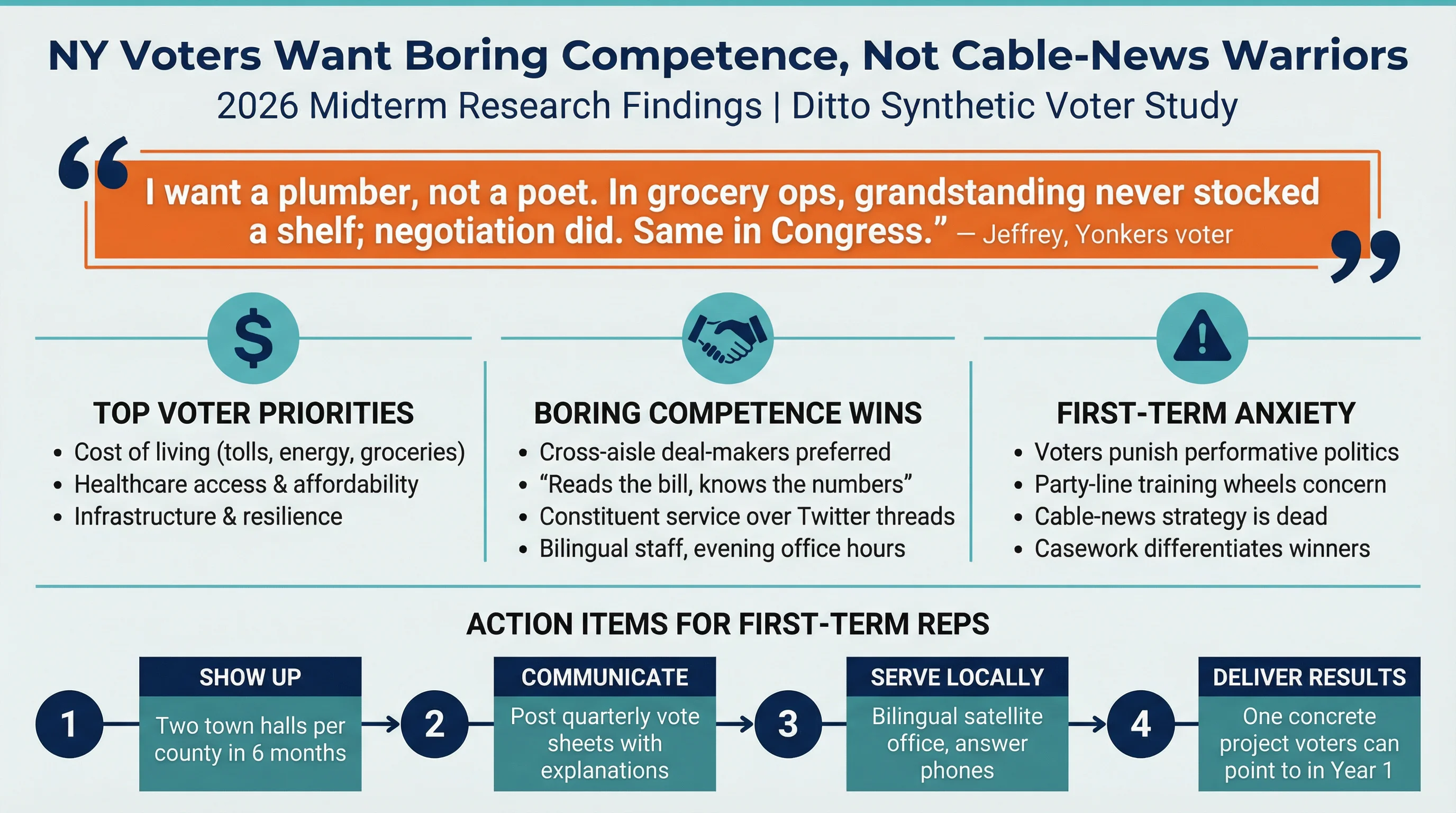
New York's congressional races are always competitive, but the 2026 midterms feel different. Several districts flipped from Republican to Democrat in recent cycles, and first-term representatives are facing the ultimate test: can they deliver enough to hold seats that could easily flip back?
I ran a study with six New York voters from Staten Island, Queens, Yonkers, and rural upstate. Their message to Congress was crystal clear: Give us boring competence. We are done with the cable-news circus.
The Participants
Six participants representing the diversity of New York: a 63-year-old bilingual tech operations pro in Staten Island (underemployed, uninsured), a 30-year-old construction foreman in Queens (night shift, uninsured, non-citizen), a 55-year-old early-retired grocery operations veteran in Yonkers caring for his 78-year-old mother, a 48-year-old bilingual elementary school teacher in rural NY, a 59-year-old production lead and union member in rural upstate, and a 56-year-old caregiver in rural NY.
What united them? A profound exhaustion with performative politics and a hunger for representatives who actually do the work.
The Issues That Will Decide 2026
When I asked participants what issues would most influence their congressional vote, three themes dominated:
Cost of living - tolls, energy bills, groceries, healthcare costs, and the squeeze that never stops
Healthcare access and affordability - Medicaid redetermination chaos, surprise billing, prescription prices, and the uninsured gap
Infrastructure and resilience - grid hardening, flood protection, rural broadband, and transit that actually works
Ronald from Staten Island was blunt: "I drive over the Verrazzano and through the Holland twice a week. Those tolls feel like a ransom. Add gas, parking, and utilities creeping up, and it eats a thin paycheck fast."
Michael, the union fabricator from rural upstate, demanded manufacturing investment: "Keep American manufacturing here, with teeth behind it. I want real Buy American in federal work, strong antidumping on cheap steel, and funding for apprenticeships that actually put kids on a shop floor, not in a brochure."
Key insight: Cost of living is not abstract for these voters. It shows up in every toll booth, pharmacy counter, and utility bill.
The Boring Competence Mandate
The most striking finding: voters overwhelmingly prefer cross-aisle deal-makers over loud progressive fighters. When asked what qualities matter most in a representative, the answers were nearly unanimous:
Boring competence - "Reads the bill, knows the numbers, says no when the math is junk."
Constituent service that works - "Returns calls, bilingual staff, office hours that include evenings. When my Medicaid got messed up, I needed a human who could nudge agencies, not a tweet thread."
Transparent votes with receipts - "Tells us how and why they voted. No buzzwords. No hiding in the fine print."
Local grind - "If you do not understand ferries, tunnels, and that insane Verrazzano toll shaping daily life, you are not my rep."
Respectful spine - "Meet with people you disagree with, but do not fold to your party's loudest 5 percent."
Jeffrey from Yonkers put it perfectly: "I want a plumber, not a poet. In grocery ops, grandstanding never stocked a shelf; negotiation did. Same in Congress."
Darlene from rural NY agreed: "Give me a quiet workhorse who can cut deals without cutting corners. If you live on cable news and Twitter, hard pass. If you live in committee rooms, town halls, and the weeds of a bill, we can talk."
Key insight: The desire for "boring competence" cuts across geographic, economic, and political lines. Voters are allergic to performative politics from both the left and right.
First-Term Anxiety
Several districts flipped recently, and voters have real concerns about first-term representatives. The worries clustered around several themes:
Performative politics - "Too many show up treating the district like a ladder rung and spend their rookie year chasing cameras. Fresh paint, loose bolts."
Party-line training wheels - "Afraid to cross their own side even when it hurts local jobs."
Weak constituent service - "Rookie staff, voicemail jail, no one calling you back on VA, SSA, or flood messes."
Culture-war detours - "Picking fights on TV while our roads, hospitals, and broadband rot."
Wesley, the construction foreman from Queens, was direct: "Mucho show, poco trabajo. Hacen clips para cable y X, pero no hacen el grind de comite, casework, permisos, fondos."
Key insight: First-term representatives are on probation. Voters have a clear 6-12 month checklist and will vote them right back out if they fail to deliver.
The Checklist for Earning Continued Support
Voters laid out exactly what first-term representatives need to do to keep their seats:
Show up in person - "Real town halls in every county, monthly. Take unvetted questions. No handlers cutting the mic."
Hire local and pick up the phone - "Publish a number with a human on it. Office hours after 5 for working people."
Work the right committees - "Transportation, ag, small business, labor. Less green room, more committee grind."
Post a scoreboard - "Quarterly: bridges fixed, broadband miles lit, grants landed, apprenticeship slots funded. Plain English, not weasel words."
Cross the aisle on boring but vital stuff - "Permitting for infrastructure, flood control, rail crossings, opioid treatment."
Deliver something tangible in year one - "I want to point at a project and say they helped torque that down."
Heather, the bilingual teacher from rural NY, was pragmatic: "I need 12-month receipts. Land two grants totaling at least million for schools or infrastructure, open a satellite office with bilingual staff, and deliver one concrete storm-resilience project we can see."
What This Means for 2026 Campaigns
If you are advising a congressional campaign in New York, here is what this research reveals:
The cable-news strategy is dead. Voters are actively punishing representatives who chase clips over casework.
Constituent service is the differentiator. Bilingual staff, evening hours, answering phones with humans - these are vote-deciders.
Cross-aisle deal-making beats ideological purity. Voters want results, not speeches. They will support whoever can actually move legislation.
Rural voters have specific, measurable demands. Broadband miles, grid hardening, flood resilience - these need to be in campaign materials with timelines.
Cost of living is the dominant frame. Every policy position should be connected to how it affects monthly bills.
The Bottom Line
New York voters are not looking for heroes. They are looking for plumbers who can fix the pipes without turning it into a press conference.
As Michael from rural upstate put it: "Bring home the bolts, not the bumper stickers."
Want to understand what your voters actually think? Ditto lets you run studies like this in hours, not weeks. Book a demo at askditto.io.