
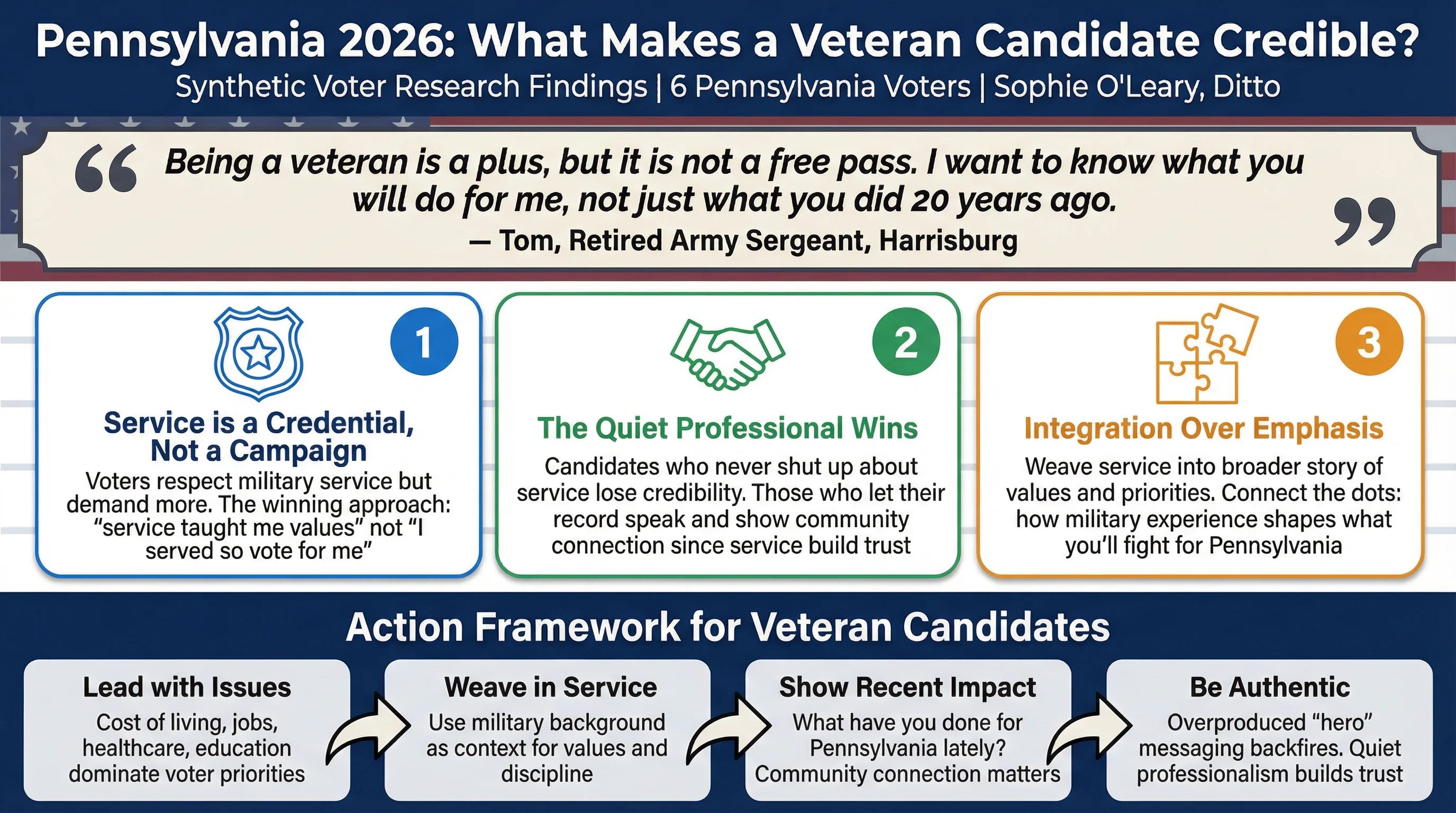
Pennsylvania has become the ultimate bellwether state, and 2026 will test whether veteran candidates can break through in a political environment that has become increasingly skeptical of all institutions, including the military. I ran a study with six Pennsylvania voters to understand what actually makes a veteran candidate credible, and whether military service still translates into electoral advantage.
The findings suggest military service matters, but not in the way most candidates assume.
The Participants
Six participants from across Pennsylvania: a steelworker in Pittsburgh, a nurse in Philadelphia, a small business owner in Allentown, a retired veteran in Harrisburg, an IT worker in Erie, and a teacher in Scranton. Ages ranged from 28 to 65, evenly split between party affiliations with significant independent presence. What united them? Exhaustion with politicians who seem disconnected from regular life.
Does Military Service Still Matter?
I asked participants directly: when a candidate emphasizes their military service, does that make you more likely to support them?
The responses revealed a nuanced picture of how military credentials play in 2026.
Tom from Harrisburg, himself a retired Army sergeant, was direct: "Being a veteran is a plus, but it is not a free pass. I want to know what you will do for me, not just what you did 20 years ago. Lots of veterans are great people but would be terrible politicians."
Maria from Philadelphia agreed: "I respect military service. But it does not tell me whether you understand healthcare costs or education funding. It is one data point, not the whole picture."
However, Dave from Pittsburgh was more receptive: "In a world full of politicians who have never sacrificed anything, a veteran stands out. They have skin in the game. They know what it means to serve something bigger than themselves."
Key insight: Military service is a credential, not a campaign. Voters respect it but demand more. The winning approach is 'service taught me values I will bring to this job,' not 'I served so you should vote for me.'
What Makes a Veteran Candidate Credible?
I pressed participants on what separates veteran candidates who connect from those who do not. The answers were illuminating.
Linda from Allentown: "The ones who never shut up about their service are usually the worst. The quiet professionals who let their record speak for itself, those are the ones I trust."
Joe from Erie: "I want to see what you have done since you got out. Military service 25 years ago is great. What have you done for Pennsylvania lately? Are you connected to the community now?"
Michelle from Scranton: "Do not just tell me you were in the military. Tell me how that experience shaped what you will fight for as a politician. Connect the dots for me."
Key insight: Credibility comes from integration, not emphasis. Veteran candidates who weave service into a broader story of values and priorities connect better than those who lead with credentials alone.
What Pennsylvania Voters Actually Want
I asked participants what issues matter most in 2026 statewide races. The priorities were clear:
Cost of living and inflation - 'Everything costs more. My paycheck buys less. Someone needs to actually address this.' (Dave)
Jobs and economic opportunity - 'Pittsburgh used to make things. We need to make things again. What is your plan?' (Dave)
Healthcare access and costs - 'Rural hospitals are closing. Prescription costs are insane. This affects everyone.' (Michelle)
Education funding - 'Our schools are falling apart. Teachers are leaving. Property taxes are crushing homeowners.' (Maria)
Energy policy - 'Pennsylvania has natural gas. Let us use it. But do it responsibly. Balance is possible.' (Linda)
Veterans issues, interestingly, were not top-of-mind even for the veteran participant.
Tom from Harrisburg: "VA care matters to me, but I care more about the economy and my kids' future. A candidate who only talks about veterans stuff is not going to win statewide."
Key insight: Veteran candidates should not lean too heavily on veterans-specific issues. Pennsylvania voters want leaders who can address universal concerns like cost of living and healthcare, using military service as credibility for broader leadership, not as a policy platform.
The Authenticity Question
What emerged most strongly was the hunger for authentic candidates in a state drowning in political performance.
Joe from Erie: "I can spot a phony from a mile away. Politicians practice their 'everyman' act in the mirror. Give me someone who actually knows what it is like to struggle, to serve, to sacrifice."
Michelle from Scranton: "The best candidates are the ones who seem like they would be doing this work whether they got elected or not. Public servants, not politicians climbing a ladder."
Dave from Pittsburgh: "Fetterman won because he seemed real. Whatever you think of his politics, he came across as authentic. That matters more than credentials in Pennsylvania."
Key insight: Military service can enhance authenticity, but only if presented genuinely. Overproduced 'hero' messaging backfires. Understated references to service that support a larger authentic narrative work best.
What This Means for Veteran Candidates in 2026
If you are a veteran running in Pennsylvania:
Lead with issues, not biography. Your service is context, not content. Tell voters what you will do for them, then explain how service prepared you.
Be the quiet professional. Understated references to service build more credibility than constant reminders. Let others praise your record.
Connect service to civilian concerns. 'The discipline I learned in the Army taught me to focus on what matters' bridges military experience to voter priorities.
Stay current. What have you done since getting out? Community involvement, business leadership, civic engagement all matter.
Emphasize universal issues. Cost of living, healthcare, education, jobs. Save veterans-specific policy for veterans audiences.
The Bottom Line
Military service remains a meaningful credential in Pennsylvania, but it is not a shortcut. Voters want veteran candidates who use their experience to inform leadership on universal concerns, not as a substitute for policy substance. The winning formula is authentic integration of service into a broader vision for Pennsylvania, not a biography-first campaign.
As Tom from Harrisburg put it: "I have voted for plenty of veterans. I have voted against plenty too. Service tells me something about character. It does not tell me what you are going to do for my state. Answer that question, and the veteran thing is a bonus. Lead with the veteran thing alone, and you have lost me."
Want to test your own campaign messaging in Pennsylvania? Ditto lets you run voter research studies like this in hours, not weeks. Book a demo at askditto.io.
What the Research Revealed
We asked Pennsylvania voters to share their thoughts. Here is what they told us:
Does a candidate's military service make you more likely to support them?
Tom Wilkins, 65, Retired Veteran, Harrisburg, PA:
It is a plus, but not a free pass. I served 22 years. I respect other veterans. But I want to know what you will do for me now, not just what you did decades ago. Lots of veterans are great people who would be terrible politicians. Service is the start of the conversation, not the end.
Maria Santos, 35, Nurse, Philadelphia, PA:
I respect military service. My brother served in Afghanistan. But it does not tell me whether you understand healthcare costs, education funding, or the economy. It is one data point among many. Show me your whole picture, not just the uniform.
Dave Kowalski, 52, Steelworker, Pittsburgh, PA:
In a world full of politicians who have never sacrificed anything, a veteran stands out. They have skin in the game. They know what it means to serve something bigger than themselves. So yes, it matters to me. But they still need to have the right ideas.
What makes a veteran candidate credible?
Linda Chen, 44, Small Business Owner, Allentown, PA:
The ones who never shut up about their service are usually the worst. They are compensating for something. The quiet professionals who let their record speak for itself, who focus on what they will do, not what they did, those are the ones I trust.
Joe Bartkowski, 58, IT Worker, Erie, PA:
I want to see what you have done since you got out. Military service 25 years ago is great. What have you done for Pennsylvania lately? Are you connected to this community now? Do you understand what regular people are dealing with today, not just what you dealt with in the barracks?
Michelle O'Brien, 28, Teacher, Scranton, PA:
Do not just tell me you were in the military. Tell me how that experience shaped what you will fight for as a politician. Connect the dots for me. If service taught you discipline, how will that help you balance a budget? Make it relevant.
What issues matter most in Pennsylvania statewide races?
Dave Kowalski, 52, Steelworker, Pittsburgh, PA:
Cost of living, full stop. Everything costs more. My paycheck buys less every month. Someone needs to actually address this. Then jobs. Pittsburgh used to make things. We need to make things again. What is your actual plan?
Michelle O'Brien, 28, Teacher, Scranton, PA:
Education and healthcare. Our schools are falling apart and teachers are leaving. Healthcare costs are crushing families. Rural hospitals are closing. These are the issues that affect everyone, not just one party or the other. Fix the basics.
Tom Wilkins, 65, Retired Veteran, Harrisburg, PA:
VA care matters to me, but I care more about the economy and my kids' future. A candidate who only talks about veterans stuff is too narrow. I want someone who understands the whole picture. Pennsylvania first, not just vets first.