
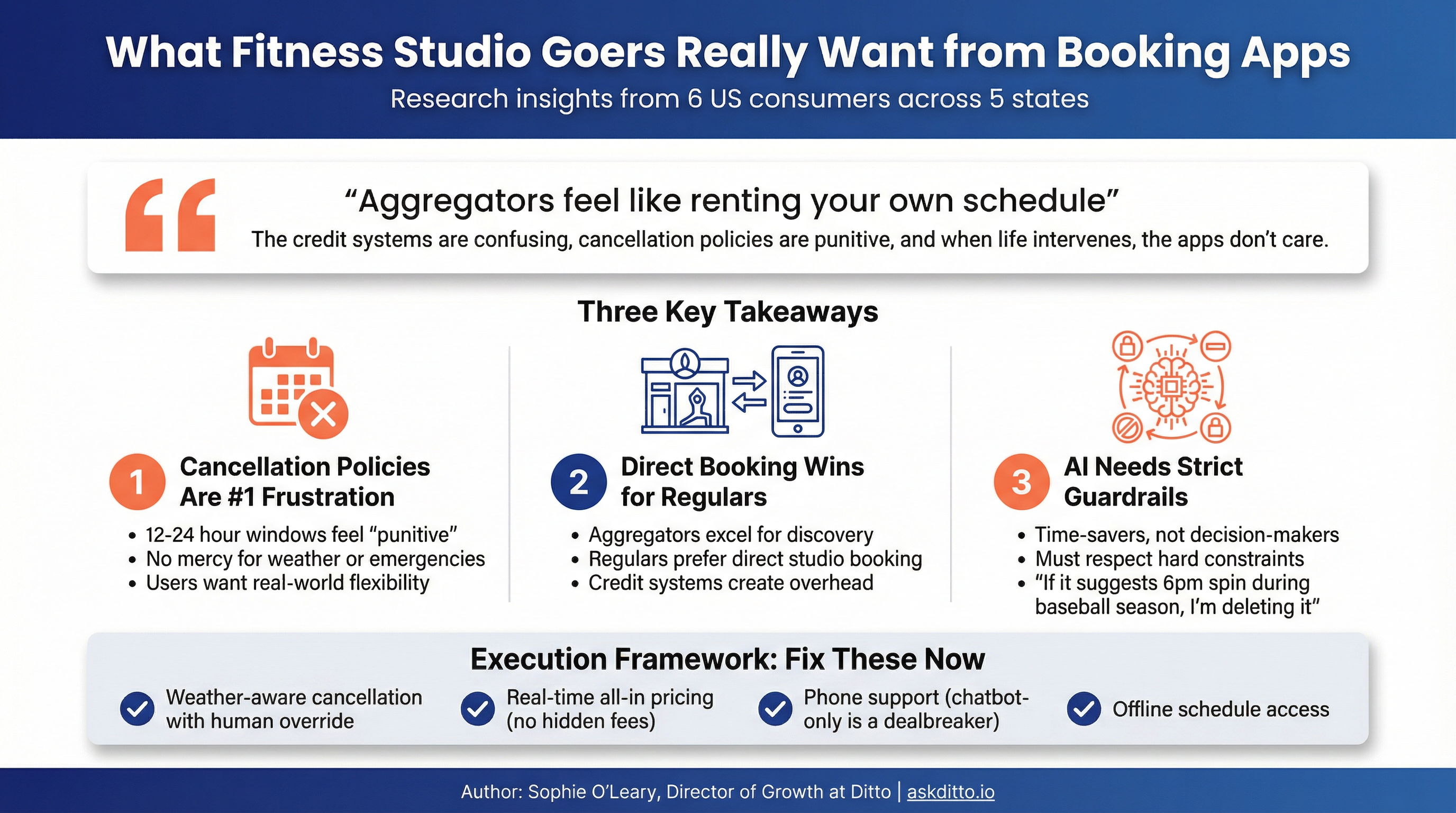
Six fitness class regulars. Three questions about how they book. One overwhelming verdict: aggregators feel like renting your own schedule. The credit systems are confusing. The cancellation policies are punitive. And when weather or life intervenes, the apps do not care.
I ran a Ditto study to understand how regular Americans (parents juggling kids, shift workers with unpredictable schedules, people in rural areas with limited options) actually experience fitness booking platforms. The frustrations run deep.
The Participants
Our panel included six US consumers aged 26-50, from Pennsylvania, Texas, Michigan, Virginia, and Louisiana. A mix of rural and urban residents, parents and singles, with household incomes ranging from under $25k to over $100k. What united them: all book fitness classes, all have tried aggregator apps, and all have strong opinions about what is broken.
The Booking Frustration Catalogue
When we asked what frustrates them most about booking fitness classes, the responses formed a clear hierarchy. Topping the list: cancellation policies.
Rigid cancellation windows are ridiculous when black ice shows up overnight.
Alexis from Pittsburgh captured the sentiment: 'A 12 or 24 hour cutoff is ridiculous when black ice shows up overnight. At -15 degrees Celsius, I'm not biking to a 6am class just to avoid a fee.'
The frustration themes were consistent:
Cancellation traps: 8-24 hour windows, full fees for no-shows during weather, waitlist auto-adds at 3am
Pricing opacity: Credits, tiers, promo rates, hidden fees appearing at checkout
Schedule mismatch: Most classes at 9am or 6pm when people need 5am or 8:30pm options
App chaos: Multiple logins, push spam, calendar sync issues, no offline mode
Capacity lies: '3 spots left' that flip to waitlist, ghost inventory, real headcounts hidden
Hope from Philadelphia summed up the emotional toll: 'I stopped going to the gym for a while; those "we miss you" push alerts with a countdown clock just poke the bruise. I don't need shame with my squats.'
Key insight: Cancellation policy frustration is not about the fee itself. It is about the lack of mercy for weather, transit delays, and life circumstances. Platforms that acknowledge real-world constraints will win loyalty.
Aggregator vs Direct Booking
We asked whether they prefer booking through aggregators like Mindbody or ClassPass, or directly with studios. The pattern was clear: aggregators for sampling, direct for living.
At home it's 80% direct, 20% aggregator when I'm in Houston or New Orleans and want a quick drop-in.
Adam from rural Louisiana explained: aggregators are fine for travel or trying new places. But at home, they 'feel like renting my own schedule.' The credit dance burns time. The quotas create pressure to cram workouts into arbitrary windows.
The tradeoffs they weigh:
Direct wins on: Relationships, flexibility, human backup when things break, clear pricing
Aggregator wins on: Discovery, variety for travel, one-time trial access
Aggregator loses on: Credit games, leftover time slots, treating users like 'second-class citizens'
Samantha from Alexandria was blunt about the tier dynamics: 'On aggregators I get the leftover slots, weird times, or "no reformer, only mat." Prime-time gets blocked. Direct, I can actually book what I want.'
Key insight: Aggregators serve discovery but lose regulars. The 'credit economy' creates cognitive overhead that drives committed users back to direct booking with studios they trust.
The AI Recommendation Opportunity
We asked if AI-powered class recommendations would be valuable. The answer was conditional: yes, but only with strict guardrails.
I'd try it if the AI actually cuts noise and respects my boundaries. If it's just buzzwords pushing me to a $40 bootcamp across town at rush hour, hard pass.
Hope from Philadelphia set the bar: AI recommendations need to respect real constraints. Her 4:45am alarms, SEPTA commute times, weather, work buffers. 'Do not suggest a class I can't realistically make.'
What would make AI recommendations valuable:
Hard constraints first: Time windows, drive radius, price caps, no-go evenings
Calendar integration: Two-way sync that reads family schedules, not just personal
Weather awareness: Storm-week credits, cancel-without-fee triggers, transit-aware routing
Explainable picks: Show why a class was suggested, let users tweak the weights
Injury-aware filters: Low-impact tags, intensity levels, 'off week' toggle
Adam from Louisiana gave the rural perspective: 'If it nails that and cuts my planning by 20-30 minutes a week, I'll use it. If it pushes 6pm spin in Lafayette during baseball season, I'm deleting it.'
Key insight: AI is welcomed as a time-saver, not a decision-maker. Users want recommendations within their stated rules, not suggestions that try to change their behaviour.
What This Means for Booking Platforms
If you are building or running a fitness booking platform, this research points to clear priorities:
Fix cancellation before anything else. Weather-aware policies and human override options will differentiate more than new features.
Show all-in pricing everywhere. The 'total cost before I tap book' standard is non-negotiable. No credit conversions, no checkout surprises.
Respect the direct booking benchmark. Your power users are comparing you to walking into a studio and talking to a human. Match that reliability.
Build AI that obeys constraints. Hard limits on time, location, and price should be inviolable. Recommendations that push outside boundaries destroy trust.
Offer phone support. Chatbot-only is a dealbreaker when payments and schedules are involved. Real humans, real phone numbers.
Enable offline access. Rural users and gym basements have spotty signal. Let people view their week's schedule without live connectivity.
The Bottom Line
Fitness booking platforms have a trust problem rooted in pricing opacity and cancellation punishment. Users are not asking for more features or fancier AI. They are asking for transparency, flexibility, and human backup when life does not go according to plan.
The platforms that win will be the ones that treat users like adults with complex lives, not revenue units to be maximised through gotcha policies and expiring credits.
Want to test how your booking experience lands with real fitness consumers? Ditto lets you run studies like this in hours, not weeks. Book a demo at askditto.io.
What the Research Revealed
We asked real fitness class bookers to share their thoughts. Here's what they told us:
What frustrates you most about booking fitness classes?
Zachary Scheff, 34, Community Organizer, Abilene, TX:
Short answer: all the nickel-and-dime junk and the scheduling mess. Hidden pricing and goofy credits, cancellation gotchas when a kid wakes up sick at 5am, schedule that ignores parents, pushy upsells, and janky apps.
Duane Cloonan, 50, Logistics Coordinator, Rural, MI:
Joined a small class setup this winter. The late-cancel fees and surprise waitlist adds tick me off the most. My shift runs long or a storm hits. Twelve hour window. I eat a fee or lose a credit.
Hope Smith, 44, Patient Access Coordinator, Philadelphia, PA:
Short answer: all of the above, but cancellation policies are what make me see red. Rigid cancellation windows, hidden fees and bait-y pricing, schedule that ignores actual working people.
Alexis Olson, 26, Content Strategist, Pittsburgh, PA:
Short answer: rigid cancellation policies and opaque pricing make me want to chuck my yoga block into the Allegheny. A 12 or 24 hour cutoff is ridiculous when black ice shows up overnight.
Adam Doubet, 38, Supply Chain Manager, Rural, LA:
Short answer: cancellation games and opaque pricing. Then a bunch of little cuts that add up, so I bail and just run or row at the shop. Cancel windows are unforgiving, waitlist traps, credit pricing nonsense.
Samantha Marchant, 32, Veteran/Student, Alexandria, VA:
Okay, hear me out: the booking part is where I lose my patience fast. Punitive cancellation windows, opaque pricing and credits, waitlist games. Life happens. Charging me $15 to not risk a fall at 6am in -12C makes me feel punished, not motivated.
Do you prefer aggregators or booking directly with studios?
Duane Cloonan, 50, Logistics Coordinator, Rural, MI:
I book direct. I like one place, one login, one bill. No credits game. No mystery fees. If weather turns or the power drops, I want to call the desk and get a straight answer.
Adam Doubet, 38, Supply Chain Manager, Rural, LA:
Short answer: I book direct. Aggregators are fine for travel or a one-off, but at home they feel like renting my own schedule.
Zachary Scheff, 34, Community Organizer, Abilene, TX:
Short answer: I book direct most of the time. I hate juggling another app and getting hit with weird credits or late fees when a kid spikes a fever.
Samantha Marchant, 32, Veteran/Student, Alexandria, VA:
Short answer: direct once I know I like the studio. Aggregators are fine for sampling on a promo month, then I bail. I'm not paying to be a second-class citizen in someone else's class.
Hope Smith, 44, Patient Access Coordinator, Philadelphia, PA:
Short answer: I mostly book direct with the studio. Aggregators are fine for sampling, but I do not trust the credit games or surprise fees.
Alexis Olson, 26, Content Strategist, Pittsburgh, PA:
Short answer: I run a hybrid. ClassPass for variety and travel, direct with the studios I actually care about keeping alive.
Would AI-powered class recommendations be valuable to you?
Duane Cloonan, 50, Logistics Coordinator, Rural, MI:
So it is actually picking classes for me, not just sorting a list? I do not care about that. I know what I do. Get stronger, keep my back happy, be home by 7. I pick by time, drive, and price. Three ideas max, not a wall of junk.
Zachary Scheff, 34, Community Organizer, Abilene, TX:
Short answer: I'd try AI picks if they're plain and useful, but I still want to browse. Don't sell me magic. Just help me find a class that fits my life without upsells or hoops.
Hope Smith, 44, Patient Access Coordinator, Philadelphia, PA:
Short answer: I'd try it if the AI actually cuts noise and respects my real life. If it's just buzzwords pushing me to a $40 bootcamp across town at rush hour, hard pass.
Adam Doubet, 38, Supply Chain Manager, Rural, LA:
Short answer: I'll use AI if it actually saves me time. If it's just cute recommendations, I'll ignore it and keep browsing. If it pushes 6pm spin in Lafayette during baseball season, I'm deleting it.
Alexis Olson, 26, Content Strategist, Pittsburgh, PA:
Short answer: I like browsing, but I'll use AI if it actually reduces decision fatigue and respects my boundaries. If it feels like a black box shoving inventory at me, I'm out.
Samantha Marchant, 32, Veteran/Student, Alexandria, VA:
Short answer: I do not trust AI picks by default. I prefer to browse by time, price, and commute. If the recommendations are humble, explain themselves, and stay inside hard limits I set, then maybe.