
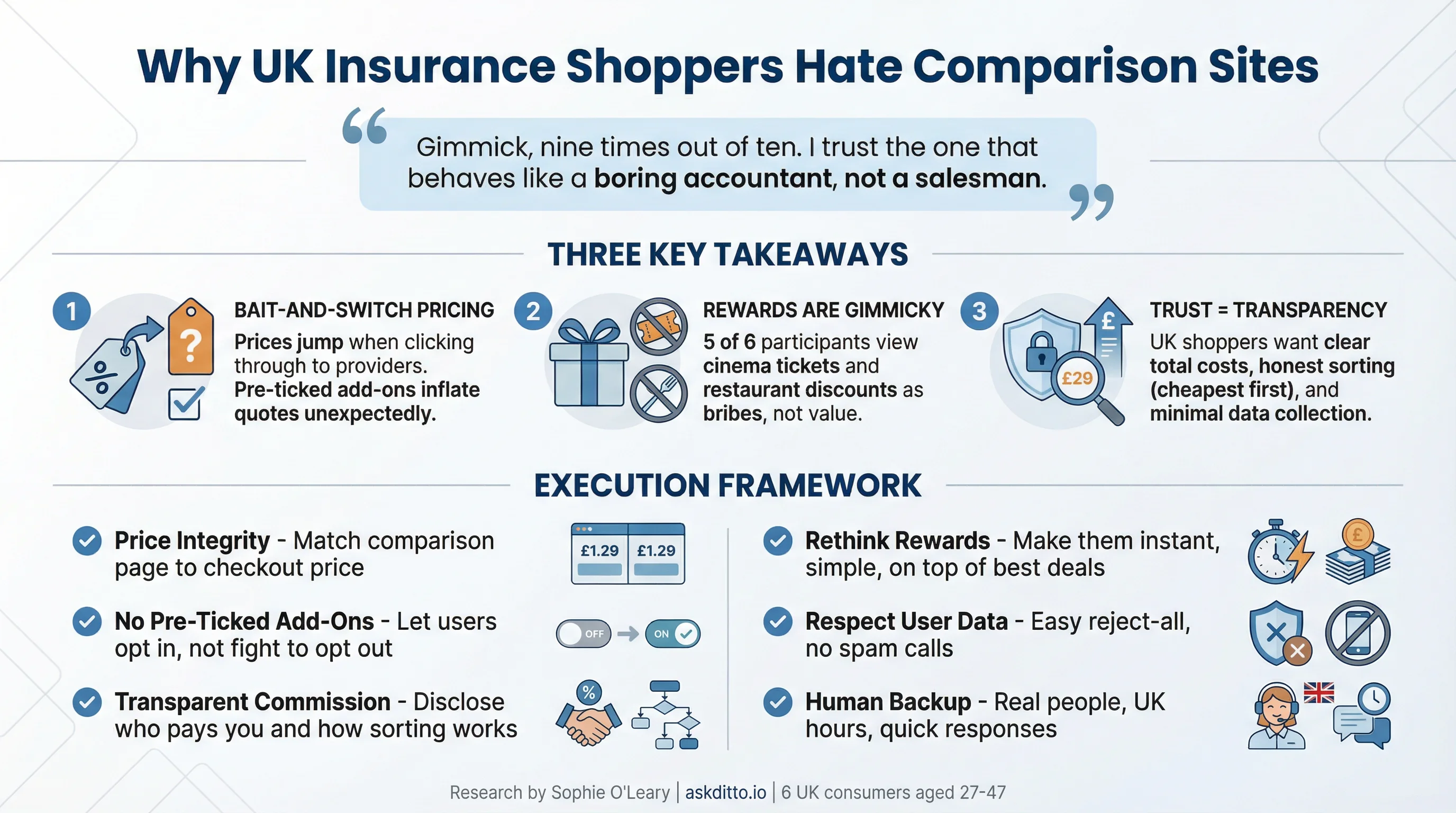
"Gimmick, nine times out of ten." That is a direct quote from a participant in this study, and honestly, it sums up how UK consumers feel about insurance comparison sites right now.
I ran a study with 6 UK consumers to understand what drives trust (and distrust) in insurance comparison websites. The findings were surprisingly unanimous: rewards programmes feel like bribes, bait-and-switch pricing is infuriating, and what people actually want is transparent, boring simplicity.
The Participants
Our panel included 6 UK consumers aged 27-47, spread across Manchester, Sheffield, Leeds, London (Croydon), Kirklees in West Yorkshire, and Newport in Wales. We had a data scientist, an electrician, a machinist, a chef, an administrative assistant, and someone between jobs. All had recently used comparison sites for insurance and all had opinions.
The Bait-and-Switch Problem
When we asked about the most frustrating part of using comparison sites, every single participant mentioned the same thing: prices that change when you click through.
One participant from Kirklees put it bluntly: "The price changing when you click through was the bit that did my head in. You see a decent quote, then on the insurer's page it's higher, or the excess is massive, or some add-on's been pre-ticked. Felt like a trap."
The pre-ticked add-ons came up repeatedly. Legal cover, courtesy car, breakdown assistance - all sneaked into quotes by default, inflating prices that looked competitive on the comparison page.
A Sheffield-based data scientist called it "add-on creep near checkout" - that frustrating moment when you realise the headline price was never the real price.
Key insight: UK consumers feel actively deceived by comparison sites. The gap between advertised and actual prices destroys trust instantly.
Rewards: Valuable or Gimmicky?
We asked participants how they feel about comparison sites offering rewards like cinema tickets or restaurant discounts. The response was overwhelmingly negative.
Five of six participants used the word "gimmicky" unprompted.
A Manchester participant explained: "Gut reaction: gimmicky most of the time. If the base deal is pricier, a free cinema ticket doesn't make it sound. I've had those restaurant rewards turn out to be weekday-only, minimum spend, 30-day expiry - useless with a four-year-old and a tight month."
The consensus was clear: rewards only feel valuable when the underlying deal is already the best. When used to compensate for a worse price, they feel manipulative.
One participant from Newport summed it up perfectly: "Mostly gimmicky. Feels like a bribe to look away from the real price."
Key insight: Rewards programmes are viewed with suspicion, not gratitude. UK consumers would rather have a straightforward lower price than navigate voucher terms and conditions.
What Actually Builds Trust
When we asked what would make participants trust one comparison site over another, the answers clustered around a few key themes.
Transparent total costs came first. Participants want to see the full 12 or 24-month cost upfront, including all fees, with no surprises at checkout.
Honest sorting was the second priority. Default sort by genuine cheapest, not "featured" or sponsored results pushed to the top.
A London electrician articulated it well: "If I cannot tell how they rank results in 10 seconds, I do not trust them."
Data respect mattered enormously. Easy opt-out, no pre-ticked marketing boxes, and especially no follow-up phone calls.
One participant mentioned getting "spam calls despite asking for email only" - a trust-killer that multiple others echoed.
Human support rounded out the list. When things go wrong, people want a real person who answers quickly, not a chatbot.
Key insight: Trust is built through boring fundamentals: transparent pricing, honest sorting, data respect, and accessible humans. Mascots and flashy features are noise.
The Job Title Roulette
One frustration came up repeatedly that deserves its own section: the arbitrary impact of job title on insurance quotes.
A Manchester participant called it "occupation roulette" - changing one word in your job description can swing prices dramatically with no clear explanation.
A Newport chef shared her frustration: "Am I catering assistant, kitchen assistant, hospital staff? One word different and the price goes sky high."
This randomness reinforces the feeling that comparison sites are designed to confuse rather than help.
What This Means for Comparison Sites
Based on this research, comparison sites that want to build genuine trust should focus on:
Price integrity - The price on the comparison page should match the price at checkout. Period.
No pre-ticked add-ons - Let users opt in to extras, not fight to opt out.
Transparent commission - Disclose who pays you and how sorting works.
Rethink rewards - If you offer them, make them instant, simple, and on top of an already-best deal.
Respect user data - Easy reject-all cookies, no spam, no surprise phone calls.
Provide human backup - UK hours, real people, quick responses.
Conclusion
UK insurance shoppers are not asking for much. They want comparison sites that behave, in the words of one participant, "like a boring accountant, not a salesman."
The current model of flashy rewards, hidden fees, and aggressive data collection is actively destroying trust. The sites that win will be the ones that strip away the noise and deliver what consumers actually want: transparent prices, honest sorting, and respect for their time and data.
Want to understand how your customers really feel about your product? Ditto lets you run studies like this in hours, not weeks. Book a demo at askditto.io.
Selected Participant Responses
When you last used an insurance comparison website, what was the most frustrating part?
Nadia Rahman, 27, Kirklees: "The price changing when you click through was the bit that did my head in. You see a decent quote, then on the insurer's page it's higher, or the excess is massive, or some add-on's been pre-ticked. Felt like a trap."
Tom Whitfield, 33, Sheffield: "The worst bit is the bait-and-switch on the final price - click through and the cheap quote balloons once you set a sane excess and match cover you actually need."
Daniel Whitaker, 33, Manchester: "The bit that did my head in was the click-through bait-and-switch - you pick a quote, land on the insurer, and suddenly the price shifts or you have to retype everything."
How do you feel about comparison sites that offer rewards like cinema tickets?
Leah Morgan-Grant, 47, Leeds: "Gut feel? Gimmick, nine times out of ten. If the base deal is already the cheapest and straight, then a free cinema ticket is a nice extra. But if the price is higher just to dangle a burger voucher, I'm out."
Siobhan O'Connor, 36, Newport: "Mostly gimmicky. Feels like a bribe to look away from the real price. If it's money off the bill up front, grand. That's real."
What would make you trust one comparison site over another?
Tom Whitfield, 33, Sheffield: "I trust the one that behaves like a boring accountant, not a salesman. Money flows upfront: clear affiliate disclosure, who owns you, who funds you, and whether listings are complete or pay-to-play."
Mateusz Nowak, 41, Croydon: "I trust the site that shows its working. If I see marketing fluff, I close the tab. Sponsored results marked as sponsored, not hidden in tiny grey text."