
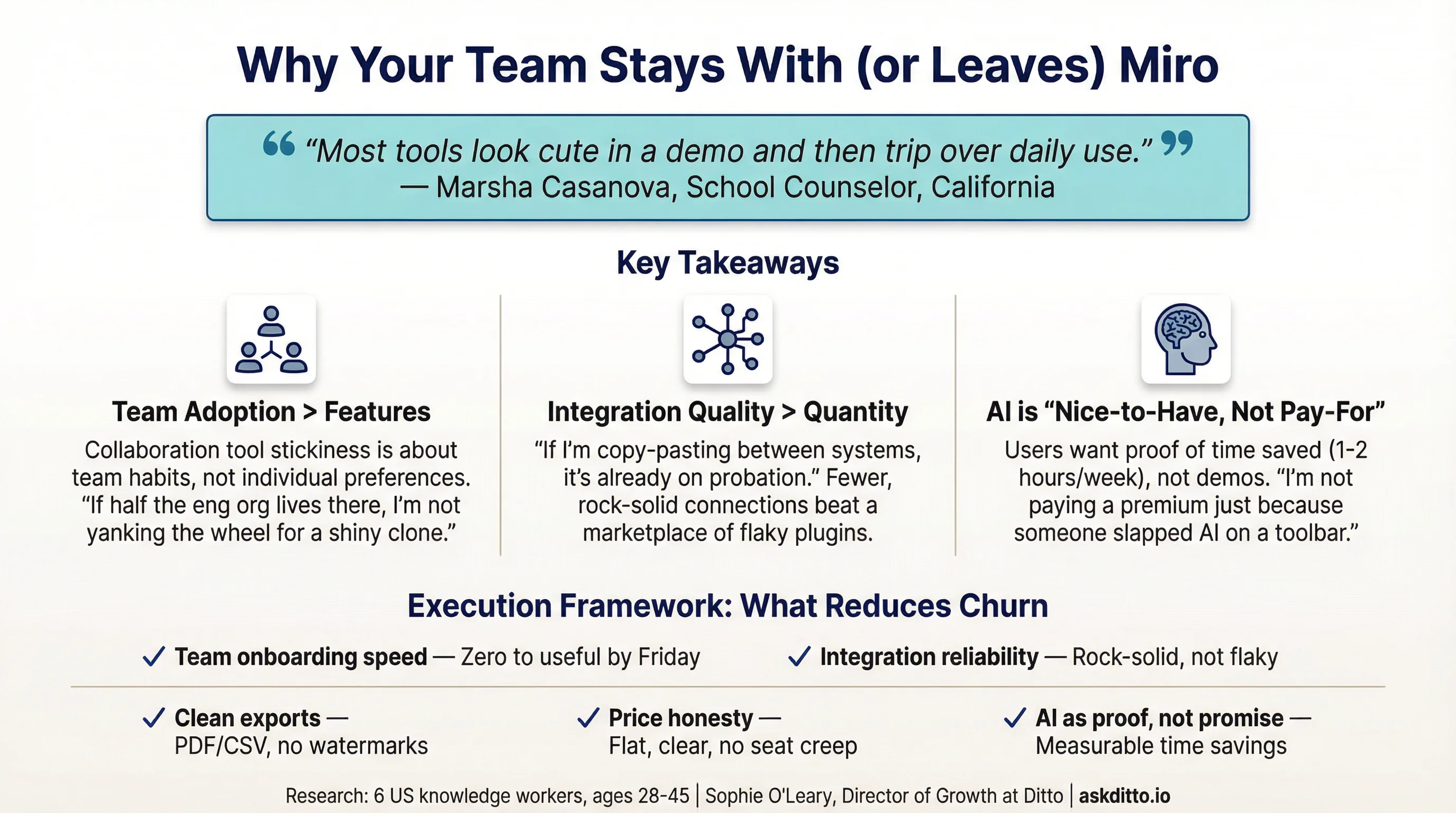
"Most tools look cute in a demo and then trip over daily use." That is Marsha, a 45-year-old school counselor in California, explaining why she is skeptical about switching collaboration tools.
I ran a study with 6 US knowledge workers to understand what drives loyalty (and churn) in collaboration tools like Miro, FigJam, and Notion. The findings reveal a stark gap between what vendors sell and what users actually need.
The Participants
Our panel included 6 US knowledge workers aged 28-45, across California, Texas, Minnesota, North Carolina, Maryland, and New York. We had a school counselor, a NASA budget analyst, a product manager, a data engineer, a construction manager, and an IT support specialist. All use collaboration tools daily and all have strong opinions about what works and what does not.
The Switching Cost Reality
When we asked what makes participants stick with a collaboration tool versus switch to a competitor, one factor dominated: team adoption.
Not features. Not templates. Team adoption.
A Houston product manager explained: "If half the eng org lives there, I'm not yanking the wheel for a shiny clone. Muscle memory, shared rituals, and existing boards/docs are the real lock-in."
A Minnesota construction manager put it even more bluntly: "15-minute tailgate and they're rolling. If two foremen still complain after a week, I kill it."
Key insight: Collaboration tool stickiness is about team habits, not individual preferences. Vendors selling features are solving the wrong problem.
The Integration Imperative
After team adoption, integrations came up as the second most critical factor.
Participants wanted their tools to connect cleanly to existing workflows: Slack, Jira, Notion, Google Drive, SSO, calendars. When integrations break or require manual syncing, frustration builds quickly.
A NASA budget analyst was emphatic: "If I'm copy-pasting between systems, it is already on probation."
A data engineer in North Carolina added: "Solid APIs, webhooks, and it talks to Slack, Jira, Notion, Git. No glue scripts every week."
Key insight: Integration quality matters more than integration quantity. Fewer, rock-solid connections beat a marketplace of flaky plugins.
AI Features: Nice to Have, Not Must Have
When we asked how important AI features are in collaboration tools, the response was surprisingly lukewarm.
Most participants described AI as "nice-to-have, not pay-for" and expressed skepticism about current implementations.
The school counselor said: "Not very, and I'm not paying a premium just because someone slapped 'AI' on a toolbar."
A construction manager was more specific: "Useful if it spits out clean daily logs, meeting minutes, and draft RFIs with timestamps, names, and links to the source. No guessing. One bad miss on a safety item and I kill it."
Participants who would consider paying for AI features set a high bar:
Proven ROI - Show me 1-2 hours saved per week, consistently, not a cute demo.
Privacy-first - On-device or tenant-isolated, data not used for model training.
Traceable - Footnotes, message links, and admit uncertainty instead of bluffing.
Audit-ready - For regulated industries, AI outputs need clear provenance.
Key insight: AI features are not driving purchase decisions in collaboration tools. Buyers want proof of time saved, not demos of capabilities.
The Remote Visual Collaboration Problem
When we asked about frustrations with remote brainstorming and planning, the answers were visceral:
Permission hell - "Someone always gets the 'request access' wall mid-call, kills momentum, and we lose 10 minutes."
Infinite canvas sprawl - "Sticky-note confetti with no owner or next step. An infinite canvas becomes an infinite junk drawer."
Cursor chaos - "Five people dragging boxes at once, lag, and 'who's driving' confusion."
Traceability gap - "What we sketch never maps cleanly to tickets. The flowchart looks great, but translating it to epics is manual and error-prone."
A NASA analyst summarised: "Whiteboard apps feel great in the moment and then rot in link purgatory. Boards are graveyards. Two months later, I cannot find the decision or the why."
What Triggers a Switch
Participants identified clear switch triggers that vendors should heed:
Data lock-in or surprise pricing - Instant deal-breaker for most participants.
Security or privacy shadiness - One bad incident or evasive answer and trust evaporates.
Integration rot - "If your sync keeps breaking and you shrug, I will not babysit your tool."
Product whiplash - Major UI changes with no notice or rollback.
Forced app downloads - "If an app is required, it better be fast, clean, and free of dark patterns."
What This Means for Collaboration Tool Vendors
Based on this research, collaboration tools that want to reduce churn should focus on:
Team onboarding speed - Can users get from zero to useful by Friday without training?
Integration reliability - Fewer, rock-solid integrations beat a marketplace of flaky options.
Clean exports - PDF and CSV that look client-ready. No watermarks, no paywall to download your own data.
Price honesty - Flat, clear pricing. No seat creep or add-on traps.
AI as proof, not promise - Pilot programs with measurable time savings, not feature announcements.
Conclusion
Collaboration tool loyalty is earned through team adoption and integration quality, not features and AI bells. The tools that win are the ones that "fade into the background and don't fight me," as one participant put it.
Vendors chasing AI hype while neglecting basics like permissions, exports, and pricing transparency are solving the wrong problems. Users want tools that respect their time and their team's habits.
Want to understand how your customers really feel about your product? Ditto lets you run studies like this in hours, not weeks. Book a demo at askditto.io.
Selected Participant Responses
What makes you stick with a collaboration tool vs switching?
Marsha Casanova, 45, Lakewood CA: "I stick when the real-world friction of switching is higher than the upside. Most tools look cute in a demo and then trip over daily use. Team adoption is first. Can my principals and teachers get from zero to useful by Friday without a PD day."
Jennifer Zapata, 35, Houston TX: "I stick for team adoption + real integrations, and I switch when the friction tax exceeds the migration pain. Muscle memory, shared rituals, and our existing boards. If half the eng org lives there, I'm not yanking the wheel."
How important are AI features in collaboration tools?
Kamrin Smith, 33, Rural NY: "Nice-to-have, not pay-for. If a collab tool is rock solid and fast, I'm happy. AI is garnish unless it reliably kills busywork. I'm allergic to paying extra for glitter."
April Carney, 44, Rural MD: "AI in collab tools is nice-to-have, not pay-a-premium must-have unless it buys me back real hours and clears compliance without drama. Prove it saves me measurable time and keeps our data buttoned up, then maybe."