
The 2026 midterms are going to be razor-thin in swing districts. Everyone knows this. What nobody agrees on is what Democrats should actually say to win.
So I ran a study with six voters from competitive swing districts across the country. Asked them what attacks actually land, how they balance democracy concerns with kitchen-table economics, and what ONE thing a Democratic candidate needs to communicate clearly to earn their vote.
The results are brutally practical.
The Participants
Six swing district voters with very different lives: a 30-year-old pregnant administrative assistant in rural Fresno who speaks Spanish at home, a 45-year-old uninsured maintenance technician from Homestead, Florida originally from Honduras, a 29-year-old former teacher and graduate student in Cincinnati, a 44-year-old Chicago courier who bikes to work and attends church regularly, a 62-year-old facilities manager in rural Iowa with his house paid off, and a 30-year-old budget analyst in rural Indiana who builds and reconciles public finance budgets.
Question 1: What Attack Ads Actually Land?
When you see attack ads against a congressional candidate, what types of attacks are most damaging to your opinion of them? What do you dismiss as typical political noise?
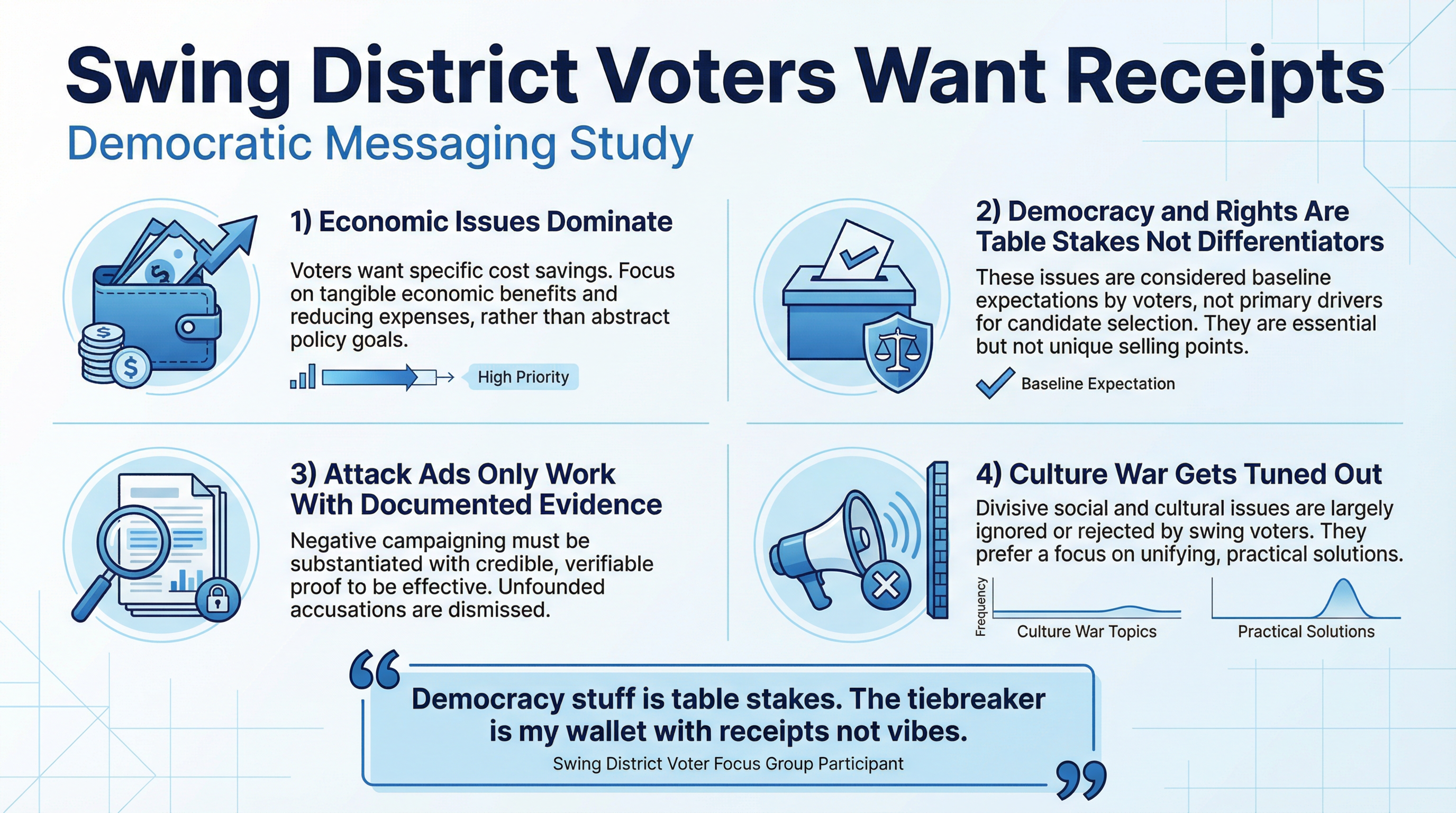
The consensus was clear: show me receipts or shut up.
"If an attack ad shows verifiable facts with dates, dollar amounts, and bill numbers, I pay attention. If it leans on spooky music and labels, I toss it with the grocery circulars." - Daniel, 30, Rural Indiana
Attacks that actually work:
Documented corruption or ethics fines with case numbers
Votes that directly raised local costs (with bill numbers)
Pattern of no-shows: missed votes, skipped town halls
Hypocrisy with a paper trail (family values talk while documented misconduct)
Anti-worker receipts: voting against wages, sick leave
Attacks that get immediately dismissed:
Scary music and black-and-white photos with no context
Culture war buzzwords: "radical," "socialist," "woke"
"Soft on crime" with grainy footage and no actual policy
Old college antics or a bad selfie from 15 years ago
Guilt by association (photo at a rally)
Question 2: Democracy vs Kitchen Table
Democrats often talk about protecting democracy and reproductive rights. How important are these compared to economic issues like inflation and jobs?
The answer: democracy is the lock, economics is the key.
"Democracy and reproductive rights are nonnegotiable for me. If a candidate is shady on voting rights or wants the state in women's doctor visits, I'm out. Full stop. After that filter, it turns into a pocket test." - Joseph, 44, Chicago
The Iowa facilities manager put it more concisely:
"The economy carries about 70 percent weight for me. But I've got two hard stops that override everything: accept election results and condemn political violence, and keep government out of the exam room." - Henry, 62, Rural Iowa
Balance they want to see:
Lock in rights: clear protections for voting access and reproductive healthcare
Concrete cost-of-living relief: housing supply, childcare, fair pay
Practical pocketbook moves: junk fee crackdowns, price transparency
No drama governance: pass budgets on time, show receipts on outcomes
Question 3: The ONE Thing
If a Democratic candidate wanted to earn your vote, what is the ONE thing they need to communicate clearly?
Every. Single. Voter. Said the same thing: show me the math.
"Show me, in numbers, that you will practice real fiscal stewardship. If you cannot point to what gets cut, delayed, or reprioritized by dollar amount and timeline, I tune out." - Daniel, 30, Rural Indiana
"It's brick cold out here. Show me, in numbers, how you're going to make my month cheaper and my check go further within a year, and how I can hold you to it." - Joseph, 44, Chicago
The Cincinnati former teacher summarized it perfectly:
"Show me the budget for public schools and the pay-for, in plain English. I want numbers, timelines, and what changes in classrooms because of it. If you can't explain how much, from where, and by when in two minutes, I don't care how inspiring your slogan is." - Brittany, 29, Cincinnati
What This Means for Democratic Campaigns
Based on this research, here's the playbook:
Democracy and rights are qualifying rounds, not differentiators. Get them right, then move on.
Lead with specific dollar amounts, timelines, and accountability measures.
Attack ads need documentation: bill numbers, case numbers, dates.
Skip the scary music and culture war buzzwords entirely.
Commit to no shutdown games and no unfunded mandates.
Publish quarterly scorecards with measurable outcomes.
The bottom line? As the Chicago courier put it: "Democracy stuff is table stakes. The tiebreaker is my wallet with receipts, not vibes."
Cheers,
Sophie