
Campaign volunteers are gold. Everyone in politics knows this. But most people have never knocked a door or made a phone bank call in their lives. So what would actually get them to do it?
I ran a study with six voters from congressional districts across the country. Asked them about their volunteer history, what makes them engage with door-knockers, and what campaign messages would motivate them to donate, volunteer, or at minimum show up to vote.
The findings are incredibly practical for any campaign trying to build a ground game.
The Participants
Six voters with different political engagement levels: a 45-year-old Seattle homeowner on a work sabbatical who volunteers at his church, a 59-year-old business development manager in rural New York, a 43-year-old maintenance technician and frugal homeowner in Oklahoma City, a 48-year-old night-shift hospital coordinator in rural Ohio managing chronic pain, a 43-year-old stay-at-home parent in Ann Arbor who speaks Korean at home, and a 50-year-old construction manager in rural Arkansas who works full-time with a disability.
Question 1: Have You Ever Volunteered?
Have you ever volunteered for a political campaign: knocking doors, making calls, or sending texts?
Most said no or barely. Those who had done it were motivated by hyper-local stakes.
"I've done it. Knocked doors for a couple local levies and a council race. What got me out the door was pretty simple: talking to neighbors beats yelling at a screen, and the church aunties don't play when they say show up." - Timothy, 45, Seattle
The Ann Arbor parent was more hesitant:
"No. I haven't done doors, calls, or mass texts. I can't vote, I'm careful about my visa, and politics feels messy and loud. Door-knocking? I don't like it when people do that to me, so I won't do it to others." - Robin, 43, Ann Arbor
What would get non-volunteers to consider it:
Issue is concrete and close to home: school funding, bus safety, local clinic staying open
Clear, low-pressure roles: data entry, setting up chairs, scripted texts, translating flyers
Short, predictable shifts: 60-90 minutes with a clean end time
Someone they trust leading it: a church mom or school parent, not a stranger
Question 2: What Makes You Listen to a Door-Knocker?
When a campaign volunteer knocks on your door or calls you, what makes you engage versus ignore them?
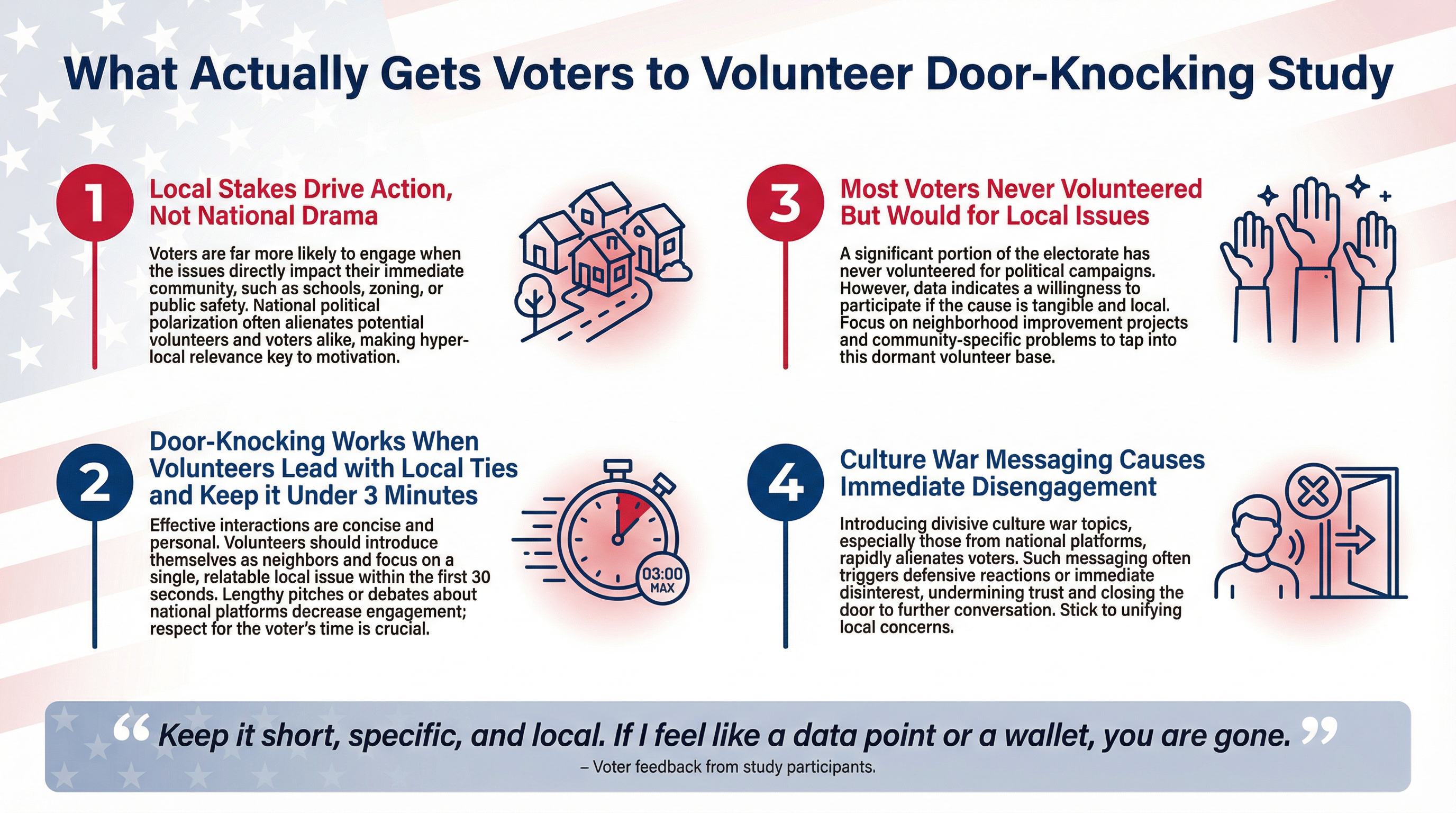
The answer was unanimous: be local, be brief, be real.
"Short, straight, local. That's what gets me to listen. Tell me who sent you from around here. Parish, VFW, FFA, school board. If you're a neighbor, I open the door. Three minutes, tops. Not at dinner." - Edwin, 50, Rural Arkansas
The rural NY business manager added:
"If you open with something concrete like, 'I'm Beth, I live off County Route 12 by the washed-out culvert,' I'm listening. If you know where my polling place actually is and the hours, even better." - Christopher, 59, Rural NY
What gets the door closed:
Leading with money or donation asks
National talking points and culture war bait
Script-reading with telemarketer cadence
Bad timing: dinner, Sunday morning, night shift sleep hours
Filming or asking for selfies
Question 3: What Would Motivate You to Act?
What messages about the stakes of an election would motivate you to actually take action: donate, volunteer, or show up to vote?
The answer: show me what changes on my block.
"Skip the soaring music and vague hand-wringing about democracy. If you want me to move, tell me exactly what will change on my block by next summer if you win vs if you lose." - Timothy, 45, Seattle
Messages that actually motivate:
Transit: "If we pass this, Route X runs every 10 minutes. If we fail, you wait 28 minutes in the rain."
Housing: "This funds right-to-counsel so families don't get bounced in winter."
Healthcare: "Cash-price clinics, late hours, no surprise bills."
Infrastructure: "Pave these streets, fix these bridges, harden the grid before ice hits."
Rural broadband: "200 addresses in my township get 100/20 by next winter."
"If it's measurable, local, and someone answers the phone when it slips, I'm in. If it's vibes and virtue, I'm out." - Christopher, 59, Rural NY
What This Means for Campaign Ground Games
Based on this research, here's the playbook for volunteer recruitment and door-knocking:
Lead with local ties: name your street, your church, your precinct.
Keep it under 3 minutes with one paper handout and a real phone number.
Offer concrete, finite volunteer asks: "Saturday 9-11, stuff envelopes at the Grange."
Never lead with money. Never do culture war. Never read scripts robotically.
Tie every message to measurable local outcomes with timelines.
Provide non-door tasks: data entry, postcards, translation, setup.
The bottom line from these voters? As the Oklahoma City technician put it: "Keep it short, specific, and local. If I feel like I'm a data point or a wallet, you're gone."
Cheers,
Sophie