
Suburban voters are the swing constituency that decides elections. But campaigns often miss what actually moves these voters - treating them as a demographic to target rather than real people with specific constraints and concerns.
I ran a study with six suburban voters from across the country - Oklahoma City, Visalia, Scottsdale, Rock Hill, Harrisburg, and Boston. Their message to campaigns? Stop marketing to a stereotype and talk to us like people who have to make Tuesday work.
The Participants
Six participants representing suburban America: a healthcare operations manager in Oklahoma City (data-driven, motorcycle commuter), a bilingual auto sales specialist in Visalia (variable commission income, faith-centered), a data analyst in Scottsdale (e-bike commuter, renter, supports family), a facilities manager in Rock Hill (non-citizen, mobile-only internet), a remote enterprise account manager near Harrisburg (single mother, Canadian non-citizen), and a hospital materials coordinator in Boston (transit-dependent, immigrant).
What united them? Every single one expressed exhaustion with campaign outreach that misses the reality of their daily lives.
The Emotional State of Suburban Voters
I asked participants what emotions come up when they think about the 2026 midterms. The answers were remarkably consistent:
Anxious - "That shooting in Minneapolis and the official story flipping after video... it hits the civil liberties nerve."
Exhausted - "The national noise machine treats us like click-throughs. Culture war bait. Zero root-cause talk."
Still engaged locally - "Local stuff actually moves the needle for me. Water policy, heat resilience, transit, small business wins."
Guardedly hopeful - "When people publish clean dashboards and own the numbers, I exhale a little."
Raven from Harrisburg captured the complexity: "Anxious first, then tired, with a thin stripe of guarded hope. I cannot vote here, which is its own special kind of frustrating, but policy still hits my mortgage, my visa, my daughter's school. I stay engaged at the local level because it actually moves the needle."
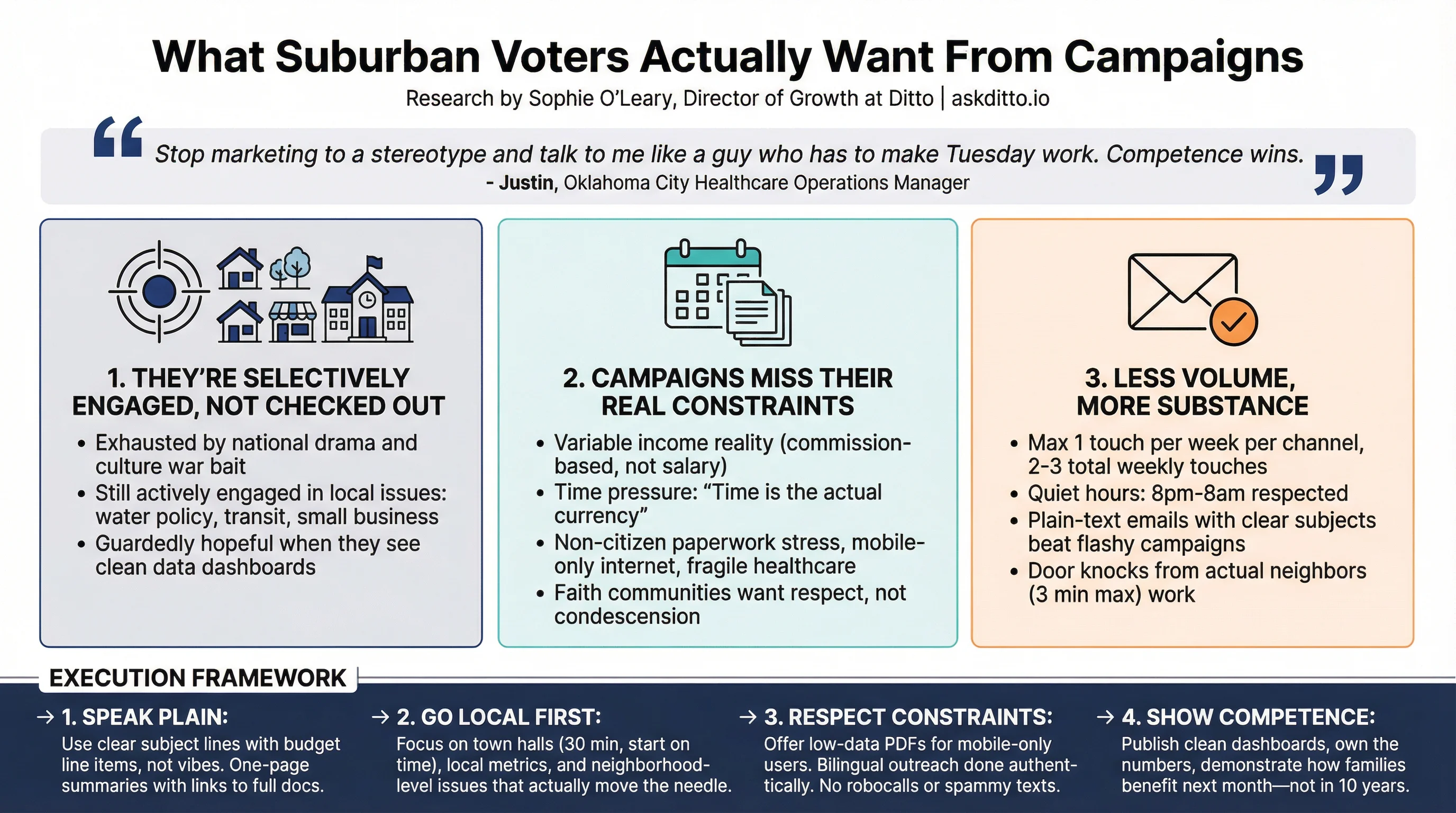
Key insight: Suburban voters are not checked out - they are selectively engaged. Local issues matter; national drama exhausts them.
What Campaign Outreach Gets Wrong
I asked participants what campaigns miss about their lives. The answers were illuminating:
Variable income reality - "I live on commissions. Big months, lean months. Do not talk to me like a salary guy."
Time constraints - "Time is the actual currency. I start before sunrise, commute Blue to Green, climb a third-floor walk-up, then help with algebra."
Non-citizen paperwork stress - "Every form feels like it can boomerang on status. SSN-only forms, background checks, clerical errors that wreck lives."
Mobile-only internet - "I hotspot. No heavy videos, no autoplay. Give me a low-data, one-page PDF."
Healthcare that is fragile - "I am on limited Medicaid. The clinic is packed. Do not promise 10-year plans. Show how families get in next month."
Faith without condescension - "Do not roll your eyes at church folks. I tithe and serve. Speak plain and do not treat us like props."
Justin from Oklahoma City was direct: "Stop marketing to a stereotype and talk to me like a guy who has to make Tuesday work at a clinic and still pay the mortgage. Competence wins."
Key insight: Campaigns treat suburban voters as a monolithic demographic. In reality, they are people managing complex constraints - variable income, time pressure, healthcare fragility, immigration paperwork - that never show up in standard messaging.
What Makes Suburban Voters Engage
I asked participants what kinds of outreach make them more likely to engage versus tune out:
What Works
Plain-text email with clear subjects - "Subject like: Heat-mitigation plan for South Scottsdale - budget and timeline. One-page summary, link to the full doc. Show line items, not vibes."
Door knock from actual neighbors - "3 minutes tops. Leave a one-pager with a QR to your policy deck."
Local forum or virtual town hall - "30 minutes with an agenda, starts and ends on time. Post a recording and a written recap with action items."
Bilingual done right - "Clean Spanish, no awkward calques, no fiesta stock imagery. Talk water, heat, transit, worker safety."
Physical mailer with numbers - "One graphic with numbers: trees planted by zip, apprenticeship slots funded. I keep those on the fridge."
What Fails
Robocalls or cold calls - "I do not answer unknown numbers. Voicemail goes straight to delete."
Spammy texts - "We saw you have not donated or four chip in \ now blasts in a day. Immediate block."
Fear-mongering ads - "After this week's mess with officials spinning a shooting, I am done with anyone playing fast and loose with truth."
Pandering Spanish - "If it reads like Google Translate, I am out."
Dark patterns - "No unsubscribe, tracking pixels, fake deadlines, triple match nonsense. Treat me like an ATM, I treat you like spam."
Jerome from Boston summed it up: "If you talk to me like a neighbor with a plan, I show up. If you treat me like a wallet with a pulse, I ghost you."
Key insight: Suburban voters want substance over volume. One clear email beats 20 spammy texts. A 30-minute town hall beats a 90-minute vibes-only rally.
What This Means for 2026 Campaigns
If you are advising a campaign targeting suburban voters, here is what this research reveals:
Local beats national. Suburban voters are exhausted by national drama but engaged on local issues. Lead with infrastructure, schools, and cost of living.
Constraints matter more than demographics. Variable income, time pressure, healthcare fragility, immigration paperwork - these shape daily life more than zip code.
Transparency is the new trust. Dashboards, metrics, timelines. If you cannot show your work, voters assume you are hiding failure.
Respect faith without weaponizing it. Acknowledge values without scolding. Show up at church basements, not for photo ops.
Bilingual outreach must be authentic. Bad Spanish is worse than no Spanish. Invest in native speakers and real community presence.
Less volume, more substance. Max one touch per week per channel. Total 2-3 touches a week across everything. Quiet hours 8 pm to 8 am.
The Bottom Line
Suburban voters are not a demographic to be targeted. They are people managing complex lives who will respond to campaigns that respect their time, understand their constraints, and show their work.
As Michael from Rock Hill put it: "If they can show up, fix one small thing I can see, and treat my paperwork, my bandwidth, and my time like they matter - I will listen. Otherwise you are just noise."
Want to understand what your voters actually think? Ditto lets you run studies like this in hours, not weeks. Book a demo at askditto.io.