
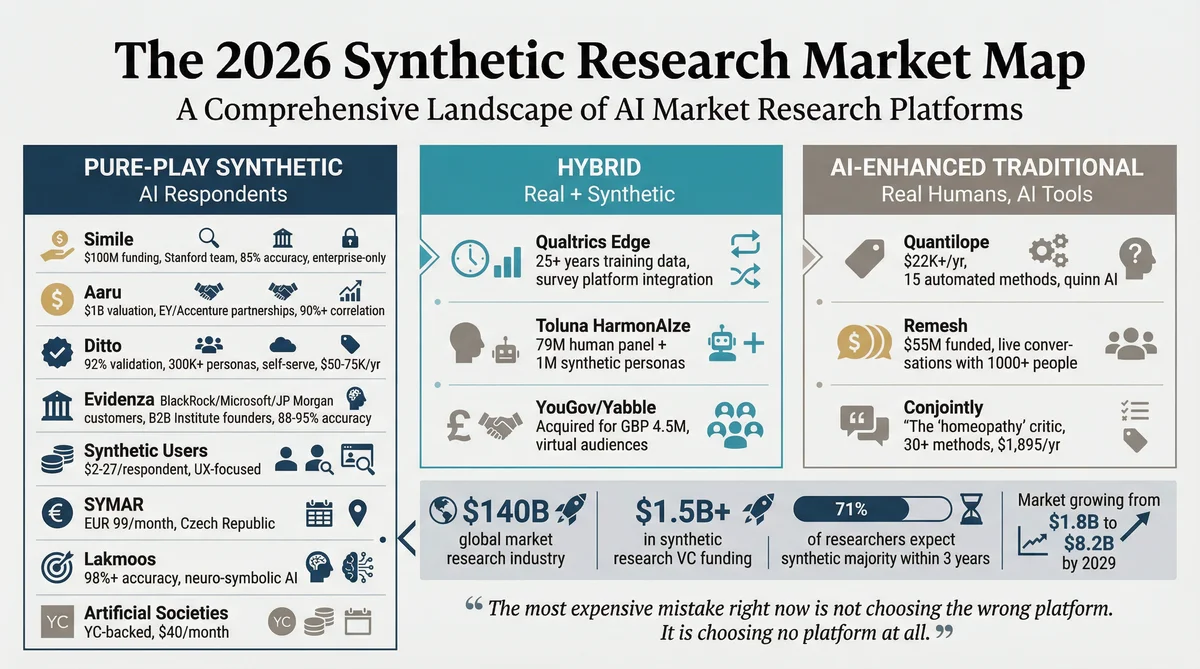
The global market research industry is worth $140 billion a year. That is, to use the technical term, a lot of money being spent asking people what they think. And in the space of roughly 18 months, an entirely new category of technology has emerged to challenge the fundamental assumption underlying all of it: that you need to ask real people.
Synthetic research platforms use AI to simulate human respondents. Instead of recruiting a panel, booking a facility, and waiting six weeks for a moderator's PowerPoint, you describe your target audience, ask your questions, and receive responses from AI-generated personas in minutes. The technology has attracted over $1.5 billion in venture capital, drawn customers including CVS Health, BlackRock, EY, and Microsoft, and prompted Qualtrics to add synthetic respondents to the world's most widely used survey platform.
It has also prompted Conjointly's founder to call the entire field "the homeopathy of market research." He has a point, though not the one he thinks he's making.
The market is moving fast enough that even seasoned research professionals are struggling to keep track of who does what, how they differ, and which platforms are genuinely novel versus which are GPT wrappers with demographic labels. This article is an attempt to map the landscape as it stands in February 2026: who the players are, how their technology actually works, what the evidence says, and where to start if you're evaluating synthetic research for the first time.
How to Read This Map
The synthetic research market splits into three distinct categories, and understanding which category a platform belongs to is the first step in evaluating it:
Pure-play synthetic platforms generate AI respondents as their core product. No real humans involved in the research itself. This is where the most interesting technology and the most heated debate lives. Players: Simile, Aaru, Ditto, Evidenza, Synthetic Users, SYMAR, Lakmoos, Artificial Societies.
Hybrid platforms combine real human panels with synthetic respondents, typically offering synthetic as an add-on to an established research infrastructure. This is where the incumbents are placing their bets. Players: Qualtrics Edge Audiences, Toluna HarmonAIze, YouGov (via Yabble acquisition).
AI-enhanced traditional platforms use AI for analysis, survey design, and moderation, but still rely on real human respondents for the actual research data. These are often the most vocal critics of synthetic research. Players: Quantilope, Remesh, Conjointly.
The boundaries between these categories are already blurring, and will blur further. But for now, they represent meaningfully different approaches to the same problem.
The Pure-Play Heavyweights
Simile: The Stanford Pedigree ($100M)
Simile emerged from stealth on 12th February 2026 with $100 million from Index Ventures, the largest single round in synthetic research. Founded by the Stanford team that literally invented generative agents (Joon Sung Park, Michael Bernstein, Percy Liang), plus commercial operator Lainie Yallen (ex-Hebbia, co-founded TriplePlay/Roblox). Backed personally by Fei-Fei Li and Andrej Karpathy.
The technology trains individual AI agents on qualitative interviews with real people, giving them memory, reflection, and planning capabilities. Published validation: 85% of human self-replication accuracy on the General Social Survey across 1,052 participants. The Gallup partnership promises probability-based synthetic panels. Known customers: CVS Health, Telstra, Suntory, Wealthfront, Banco Itau.
Access: Enterprise-only, demo required. Pricing: Not published; estimated $100,000-$250,000+/year. Best for: Fortune 500 companies with complex behavioural simulation needs.
Aaru: The Unicorn ($1B Valuation)
Aaru is Simile's most direct competitor for enterprise dominance. Founded in March 2024 by Cameron Fink, Ned Koh, and John Kessler, the company raised $50 million+ in a Series A led by Redpoint Ventures in December 2025 at a headline $1 billion valuation (blended valuation was lower due to tiered investor pricing). Accenture both invested in and partnered with Aaru through its Accenture Song creative business.
The validation story is strong: EY recreated their annual Global Wealth Research Report using Aaru in a single day with 90%+ median correlation to the original six-month study. Aaru also predicted the outcome of the New York Democratic primary. IPG (Interpublic Group) uses Aaru to simulate audience reactions for brand campaigns.
Access: Enterprise-only. Pricing: Not published; enterprise tier. Best for: Management consulting, financial services, political research, large agency groups.
Ditto: The Self-Serve Challenger
Ditto takes a fundamentally different architectural approach. Rather than training agents on individual interviews (Simile) or building multi-agent prediction engines (Aaru), Ditto grounds synthetic personas in population-level data: census demographics, consumer behaviour patterns, attitudinal surveys, and regional preference data across 50+ countries. The result is 300,000+ pre-built personas calibrated against real-world distributions.
Published validation: 92% overlap with traditional focus groups across 50+ parallel studies. The platform is self-serve (create an account, run a study immediately) with integrations into Figma, Canva, and Framer for in-tool design feedback. This makes Ditto the most accessible of the major platforms for product teams and brand founders who need answers this week.
Access: Self-serve, immediate. Pricing: $50,000-$75,000/year, unlimited studies. Best for: Brand teams, product managers, agencies, and anyone who needs frequent research without enterprise procurement.
Evidenza: The B2B Institute Alumni
Evidenza is the dark horse of the market. Founded in January 2024 by Peter Weinberg and Jon Lombardo, who previously co-founded LinkedIn's B2B Institute and produced some of the most widely cited work in B2B marketing (the 95:5 Rule, the Laws of Growth in B2B). Joined by CTO Brian Watroba (ex-Facebook). Advisors include Mark Ritson and Linda Boff (former CMO of GE).
Evidenza reportedly generated seven figures in revenue from major US brands before exiting stealth mode, suggesting they may be revenue-funded rather than VC-backed. The customer list is remarkable for an apparently bootstrapped startup: BlackRock, Microsoft, JP Morgan, Nestle, EY, ServiceNow, Salesforce, Mars, Dentsu.
The technology creates thousands of AI personas for each study with unique demographics, preferences, and buying habits, then runs both quantitative surveys (100% completion rate) and qualitative interviews. Their unique feature is "Synthetic CMOs": AI clones of marketing luminaries including Byron Sharp, Mark Ritson, Les Binet, and Peter Field, whom marketers can consult for strategic feedback. This is a genuinely distinctive capability.
Published validation: 88% average accuracy across 100+ head-to-head tests. EY CMO Toni Clayton-Hine reported 95% correlation when comparing synthetic to their actual Global Brand Survey of C-suite executives. Dentsu achieved 0.87 correlation with their proprietary CCS panel dataset.
Access: Full-service (expert-led, 72-hour turnaround). Self-serve platform on waitlist. Pricing: Custom; estimated $50,000-$100,000+ per engagement. Best for: Enterprise B2B marketing teams, CMOs who need board-ready go-to-market plans.
The Accessible Tier
Not every organisation has a six-figure research budget. These platforms offer synthetic research at price points that individual researchers, startups, and small teams can actually reach.
Synthetic Users: The UX Specialist ($2-$27/respondent)
Synthetic Users focuses on product and design teams rather than brand researchers. Each synthetic user can engage in open-ended conversations (not just structured surveys), with an OCEAN personality model ensuring behavioural consistency. The multi-agent architecture uses separate "planner," "interviewer," and "critic" agents. Pay-per-respondent pricing ($2-$27 depending on complexity) makes it the lowest-barrier entry point for trying synthetic research.
SYMAR: The European Contender (€99/month)
Formerly OpinioAI, this Czech Republic-based platform recently rebranded and offers synthetic surveys, focus groups, and creative testing from €99/month. Their standout feature, "Synthetic Memories," lets users inject real data (past surveys, CRM records) into personas to ground responses in actual customer behaviour rather than LLM hallucination. Small team (approximately 2 employees), JIC-backed, with a Belkin case study showing synthetic insights "indistinguishable from historical human data."
Lakmoos: The Neuro-Symbolic Approach (€10K pilot)
Another Czech startup, Lakmoos differentiates on technology: it uses neuro-symbolic AI (combining neural networks with symbolic reasoning) rather than pure LLMs. This hybrid architecture reportedly achieves 98%+ similarity scores across 20 client benchmark studies in 2025. They target regulated industries (automotive, finance, energy) where the explainability of neuro-symbolic approaches has advantages over black-box LLMs. €10K for a one-month pilot programme.
Artificial Societies: The Y Combinator Play ($40/month)
Backed by Y Combinator and Kindred Capital, Artificial Societies simulates entire target audience groups from a database of 500,000+ AI personas, primarily for predicting social media performance and marketing campaign effectiveness. Each simulation auto-generates 10 alternate content variations. Claims 80%+ accuracy in predicting social performance versus 62.5% for generic LLMs. At $40/month for unlimited simulations, it's the cheapest option in the market.
The Hybrid Incumbents
The traditional research giants aren't sitting still. They're adding synthetic capabilities to their existing real-human infrastructure, creating hybrid platforms that let researchers toggle between synthetic and traditional respondents within the same workflow.
Qualtrics Edge Audiences
Announced in March 2025 at Qualtrics X4, Edge Audiences embeds synthetic respondents directly into the world's most widely used survey platform. The model is fine-tuned on millions of authentic human responses from Qualtrics' 25+ year research data repository. A partnership with PureSpectrum feeds additional marketplace data back into the model. Currently limited to US General Population (English), with expansion planned for 2026.
The strategic advantage is obvious: for the thousands of enterprise organisations already paying for Qualtrics, synthetic respondents become a toggle rather than a new vendor. Booking.com reportedly achieves 50% cost reduction using Edge Audiences. Google Labs used it to test a sensitive AI application without involving human participants.
Access: Existing Qualtrics subscription required. Pricing: Credit-based add-on; not publicly disclosed.
Toluna HarmonAIze & YouGov (via Yabble)
Toluna, which operates a 79-million-member human research panel, launched HarmonAIze Personas in February 2025: synthetic respondents built from their anonymised first-party data. Over 1 million unique personas already created across 15 markets and 9 languages. Each persona is a distinct individual (not a segment average), enriched with demographic, psychographic, lifestyle, and consumption attributes.
YouGov took the acquisition route, purchasing New Zealand-based synthetic research pioneer Yabble for GBP 4.5 million in August 2024. Yabble's "Virtual Audiences" technology is being integrated into YouGov's products. Yabble claims 90% insight similarity versus traditional methods at $800/month.
The pattern is clear: every major panel company is building or buying synthetic capabilities. The incumbents' advantage is their proprietary real-human data, which trains more grounded synthetic models. Their disadvantage is speed of execution and the organisational gravity of legacy businesses.
The Sceptics' Corner
Not everyone is celebrating. The most articulate criticism comes from Nik Samoylov, founder of Conjointly, who published a detailed takedown calling synthetic respondents "the homeopathy of market research." His argument: synthetic agents don't experience products, don't have real preferences, and don't make real purchasing decisions. What they produce is a statistical echo of training data.
To prove his point, Samoylov ran the same demographic profile with slightly different prompt wording. Mean household income varied from $111,348 to $272,014 across attempts. His conclusion: responses depend on "how prompts are worded rather than actual respondent characteristics."
This criticism has genuine merit, and anyone evaluating synthetic research should take it seriously. But it also has a blind spot. Samoylov tests whether synthetic respondents can replicate individual-level precision (they can't, reliably). The commercial case for synthetic research rests on aggregate-level directional accuracy: can a synthetic panel tell you whether your target market prefers concept A or concept B? The published evidence (85-95% correlation across multiple platforms and validation studies) suggests the answer is frequently yes, at a fraction of the cost and time.
The honest assessment: synthetic research works well for directional insights, concept testing, and hypothesis generation. It works poorly for precision measurement, emotional depth, and predicting specific individual behaviour. The skill is knowing which questions it can answer.
The AI-Enhanced Traditional Players
A third category of platform uses AI extensively but still relies on real human respondents for the research data. These are worth understanding because they represent the "automate the process, not the people" approach.
Quantilope ($22,000+/year): Hamburg-based, $40M funded, 300+ enterprise brand clients including Nestle, Kraft Heinz, and Estee Lauder. Offers 15 automated advanced research methods (conjoint analysis, MaxDiff, implicit association testing, Van Westendorp pricing). Their quinn AI co-pilot handles survey design, analysis, and reporting. Uses real respondents only. Voted #1 Technology Supplier in the 2024 GRIT Report.
Remesh ($3,500+/engagement): Cleveland-based, $55M funded (General Catalyst-led), with 78 employees. Runs live conversations with up to 1,000 real participants simultaneously, using AI for real-time sentiment analysis, thematic clustering, and moderation. Not synthetic; AI handles the analysis, not the responding.
Conjointly ($1,895/year Professional): Sydney-based, bootstrapped to 70+ employees and 5,000+ projects. Offers the deepest toolkit of any platform on this list: conjoint analysis (3 variants), MaxDiff, Van Westendorp, Gabor-Granger, BPTO, Kano modelling, A/B testing, creative testing, and more. All with real human respondents via Cint's marketplace. Their anti-synthetic stance is a competitive differentiator, not just an opinion.
These platforms represent the current gold standard for methodological rigour. The trade-off: they cost more per study, take days rather than minutes, and require recruiting real participants. For high-stakes decisions where precision matters, they remain the safer choice. For speed, scale, and exploratory research, synthetic platforms are pulling ahead.
How to Navigate This Market
By Budget
Under $1,000/year: Artificial Societies ($40/month), Conjointly Free tier (limited)
$1,000-$10,000/year: SYMAR (€99/month), Synthetic Users ($2-$27/respondent), Conjointly Professional ($1,895/year)
$10,000-$50,000/year: Quantilope ($22,000+), Lakmoos (€10K pilot)
$50,000-$100,000/year: Ditto ($50-$75K, unlimited studies), Evidenza (custom)
$100,000+/year: Simile, Aaru, Qualtrics Edge (add-on)
By Use Case
Consumer brand research: Ditto (broadest validation), Simile (deepest agent architecture)
B2B enterprise marketing: Evidenza (B2B Institute pedigree, Synthetic CMO feature)
UX and product testing: Synthetic Users (conversational), Ditto (Figma/Canva/Framer integrations)
Management consulting/PE: Aaru (EY/Accenture partnerships), Evidenza (board-ready output)
Pricing research: Conjointly (Van Westendorp, Gabor-Granger, conjoint), Quantilope (automated pricing methods)
Social media prediction: Artificial Societies (purpose-built)
Regulated industries: Lakmoos (neuro-symbolic explainability), Quantilope (ISO certified)
Survey augmentation: Qualtrics Edge (if you're already on Qualtrics)
By How Quickly You Need to Start
Today: Ditto, Synthetic Users, SYMAR, Artificial Societies, Conjointly
This month: Evidenza (72-hour full-service), Lakmoos (€10K pilot)
This quarter: Simile, Aaru, Qualtrics Edge, Quantilope, Toluna (enterprise sales required)
Where This Market Is Going
Qualtrics research shows 62% of market researchers have already used synthetic data, and 71% believe it will constitute the majority of research within three years. Andreessen Horowitz has called it "a new era of instant insight." The synthetic data market is projected to grow from $1.8 billion in 2024 to $8.2 billion by 2029.
Three trends will shape the next 12 months:
Hybrid workflows become standard. Synthetic for rapid hypothesis testing and iteration, real humans for high-stakes validation. Qualtrics, Toluna, and YouGov are already building this. Expect every major panel company to follow.
Validation standards emerge. The market currently lacks agreed benchmarks for accuracy. Every platform cites different numbers measured differently. Industry bodies (ESOMAR, MRS) will publish frameworks within two years. Platforms with robust, published validation will benefit enormously.
Prices fall, access widens. Today's enterprise tier ($100K+) becomes tomorrow's professional tier. Self-serve access becomes the norm. The platforms that survive will differentiate on data quality, integrations, and accuracy, not pricing opacity.
The most expensive mistake right now isn't choosing the wrong platform. It's choosing no platform at all. The organisations building institutional knowledge about synthetic research today will have a decisive advantage when the mainstream catches up. That process is happening faster than most people realise.
Phillip Gales is co-founder at Ditto, one of the platforms reviewed in this article. He has tried to represent all platforms fairly based on publicly available information, but acknowledges his obvious interest. Readers should evaluate each platform independently.