Simulating the Human Mind
The technical blueprint for cognitively grounded synthetic personas
Introduction: why mind simulation changes what market research can measure
Market research has always faced a structural limitation: human participants are expensive, slow to recruit, unevenly available across segments, and difficult to re-contact under precisely repeated conditions. Even when you can field a statistically representative sample, the act of measurement itself introduces noise—fatigue, context effects, demand characteristics, and social desirability bias. This is not a criticism of human research; it is simply the reality of observational data collection in real-world conditions.
Our approach uses a mind simulation architecture to produce synthetic personas that behave like stable, longitudinal research participants. The key is not just high-quality language generation. The system maintains persistent internal state, structured memory, probabilistic beliefs, affect dynamics, and social relationships—then routes perception and decision-making through those components. The result is a population of agents that can be run repeatedly under controlled manipulations, yielding distributions and variance patterns that are analyzable using the same statistical tools used in applied survey research, choice modelling, and behavioural measurement.
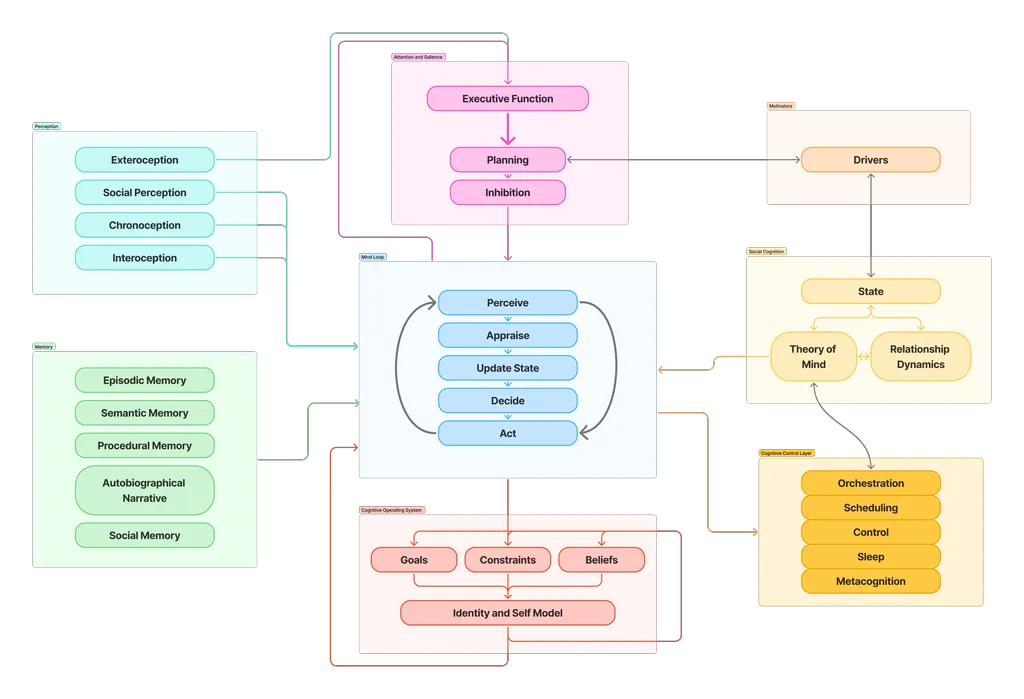
This article explains the architecture of that system in a technically precise way. It is written from the perspective of a statistical market researcher because the most important question is not “does it sound human?” but “does it behave like a measurable human system under experimental and quasi-experimental conditions?”
The Mind Loop: the runtime engine of a synthetic person
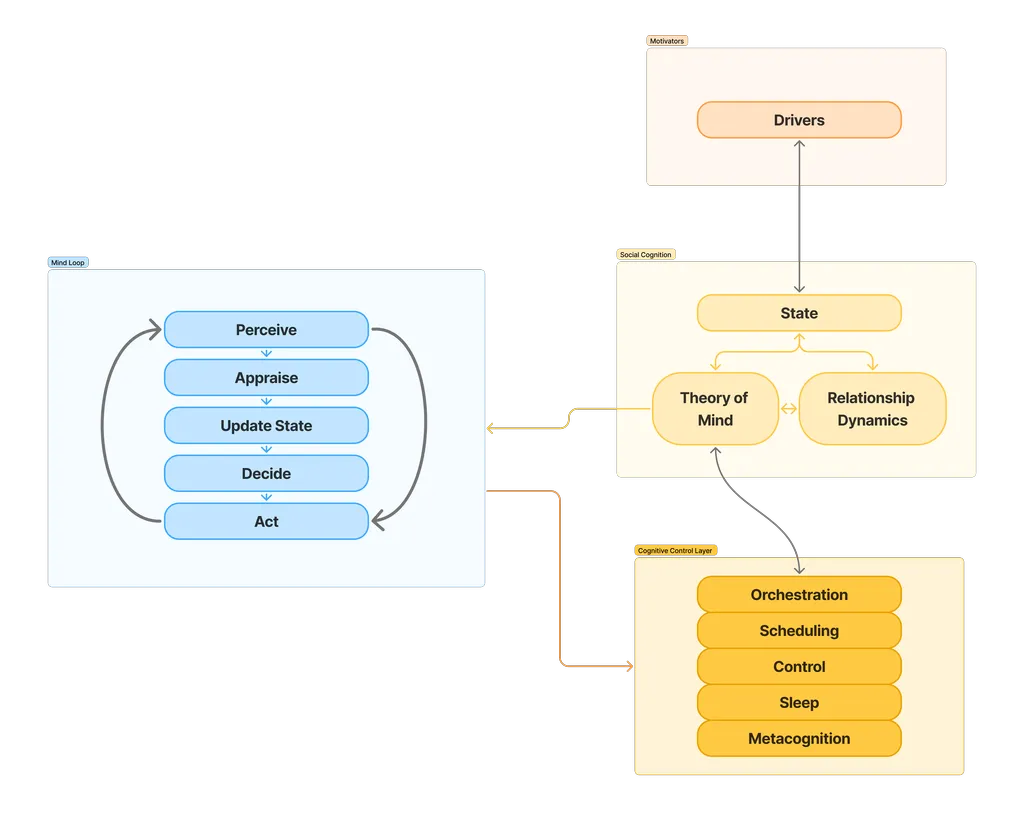
At the core of our system is a closed-loop cognitive runtime that mirrors the structure of human cognition in a way that is operationally useful. A synthetic person is not a static prompt or a single LLM call; it is a continuously updating agent whose outputs are a function of prior experiences, current context, internal state, and the information environment. This is implemented as a loop that executes on a schedule and is also triggered by events (new information, social interaction, decision points).
The loop executes six steps:
Perceive: ingest structured observations from the external and internal environment, including news, weather, messages, tasks, time-of-day cues, and ambient situational factors.
Appraise: interpret what those observations mean in relation to the agent’s goals, beliefs, values, and social position.
Update State: adjust affect, drive deficits, priorities, and belief confidence. This is where the agent’s latent variables move.
Decide: select an intention under constraints, balancing habitual responses with deliberative planning.
Act: produce language output and/or tool actions, including information seeking, plan execution, or social interaction.
Reflect: consolidate what happened into memory, update self-narrative, and revise models of other people.
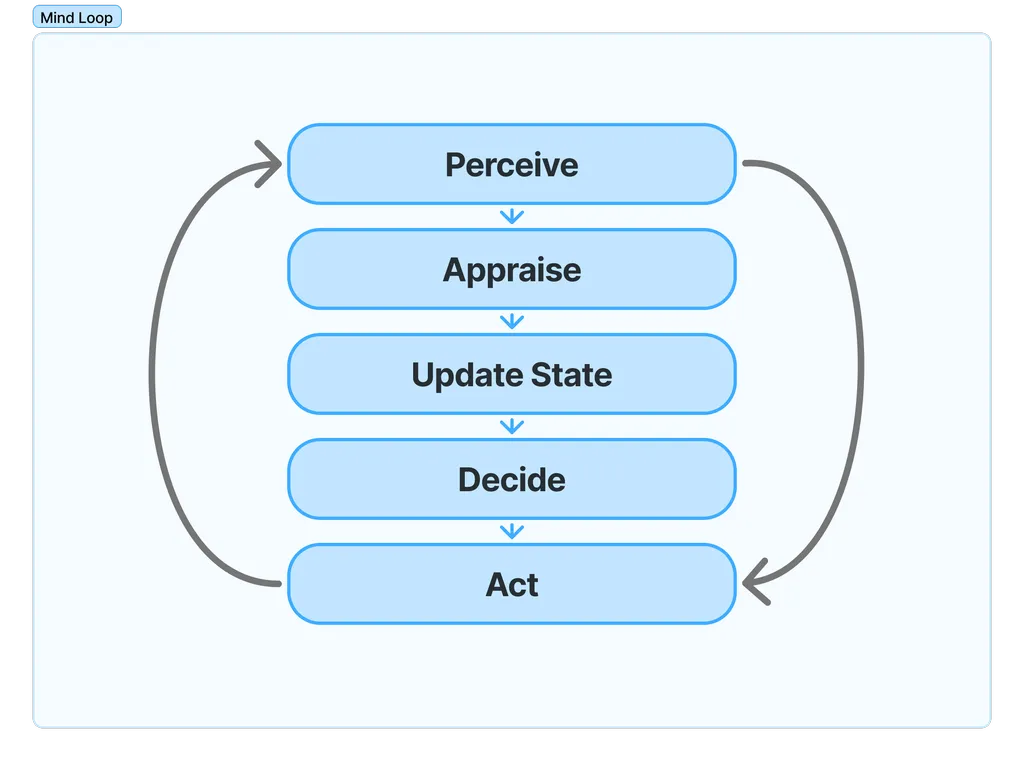
From a measurement perspective, the Mind Loop is what enables longitudinal consistency. It ensures that the agent’s outputs are not just plausible in isolation but connected across time, with stable individual differences and realistic within-person variance.
Perception: multi-stream observation ingestion with measurable features
Human perception is best understood as an integration of streams rather than a single channel. In practice, consumer decision-making depends on what is perceived, what is ignored, and what is emotionally tagged as important. Our system represents perception as distinct observation channels that each produce structured “percepts” with comparable metadata. This allows the system to treat perception as data—something that can be logged, audited, and experimentally manipulated.
The principal perception streams are:
Exteroception: external information such as news, pricing changes, product exposure, advertising stimuli, and category-level signals (availability, trend cues, social discourse).
Social perception: incoming messages, conversational tone, politeness cues, status cues, group norms, and social threat/reward signals.
Chronoception: time passage, deadlines, routine stage, seasonality, and the perception of “how long something has been going on.” This is critical for modelling impatience, procrastination, and time discounting.
Interoception: a structured internal stream representing bodily proxies such as energy, hunger, discomfort, stress load, and recovery state. These variables drive realistic fluctuations in patience, impulsivity, and effort.
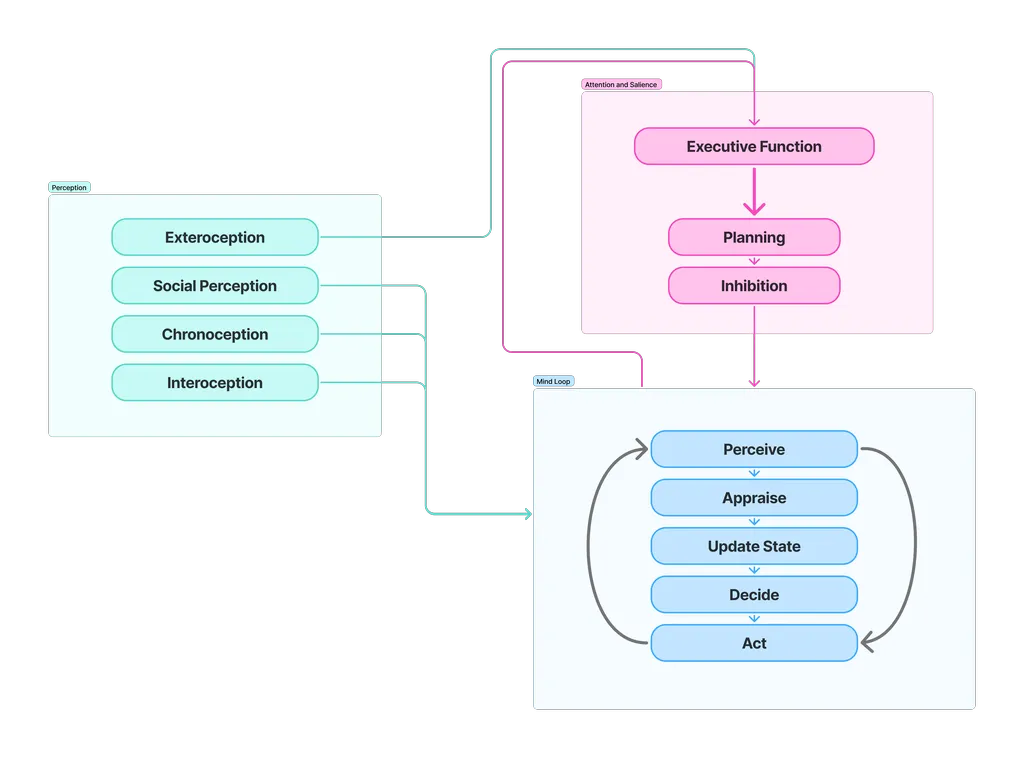
Each observation is annotated with features that are highly relevant for analytics:
Source (and source class), plus reliability weighting
Novelty and redundancy relative to what is already known
Goal relevance, including specific goals activated by the observation
Urgency, including time sensitivity
Valence and intensity, capturing affective tagging
Predicted impact magnitude, allowing attention and planning depth to adapt
This design choice addresses a common failure mode in synthetic respondents: over-processing and hyper-rational integration of all available information. Humans do not do that. They perceive selectively and unevenly. The perception layer ensures the system produces the same kind of selective exposure and selective attention patterns that researchers see in real respondents.
Attention and salience: the spotlight that determines what gets processed
Attention is the limiting resource that makes human cognition look “bounded.” In research terms, attention is the mechanism that explains why the same person can appear deeply thoughtful in one context and superficial in another. It also explains why messaging effects are so conditional: an ad cannot influence a choice if it never enters attention, and a news event cannot shift attitudes if it is not considered relevant or emotionally salient.
Our system implements a salience model that scores incoming observations and selects a top-K subset to enter working memory. The salience score is a weighted mixture of the factors that consistently predict recall and behavioural influence:
Novelty: new information competes strongly for attention.
Emotional intensity: threat and opportunity signals rise quickly.
Goal relevance: information aligned with current concerns is amplified.
Social significance: status, belonging, and conflict cues dominate attention allocation.
Uncertainty: ambiguous or unresolved issues generate repeated checking behaviour.
Repetition: persistent concerns become cognitively “sticky” even without new information.
Once salience is computed, it governs downstream cognition: what the agent “thinks about,” what it rehearses, what it stores strongly, and what triggers planning or avoidance. In behavioural terms, this produces realistic tunnel vision under stress, diffuse attention during high arousal, and narrow goal focus when deadlines approach. For market research use cases, it also yields plausible patterns of question-order effects and context effects, because salience is not fixed—it changes with the informational environment.
State: the structured internal variables that make behaviour consistent
A high-performing mind simulation requires explicit internal state that persists across sessions. Without structured state, the LLM becomes the de facto state container, which leads to drift, inconsistency, and poor auditability. We instead treat state as a formal representation of latent variables that researchers care about and can interpret.
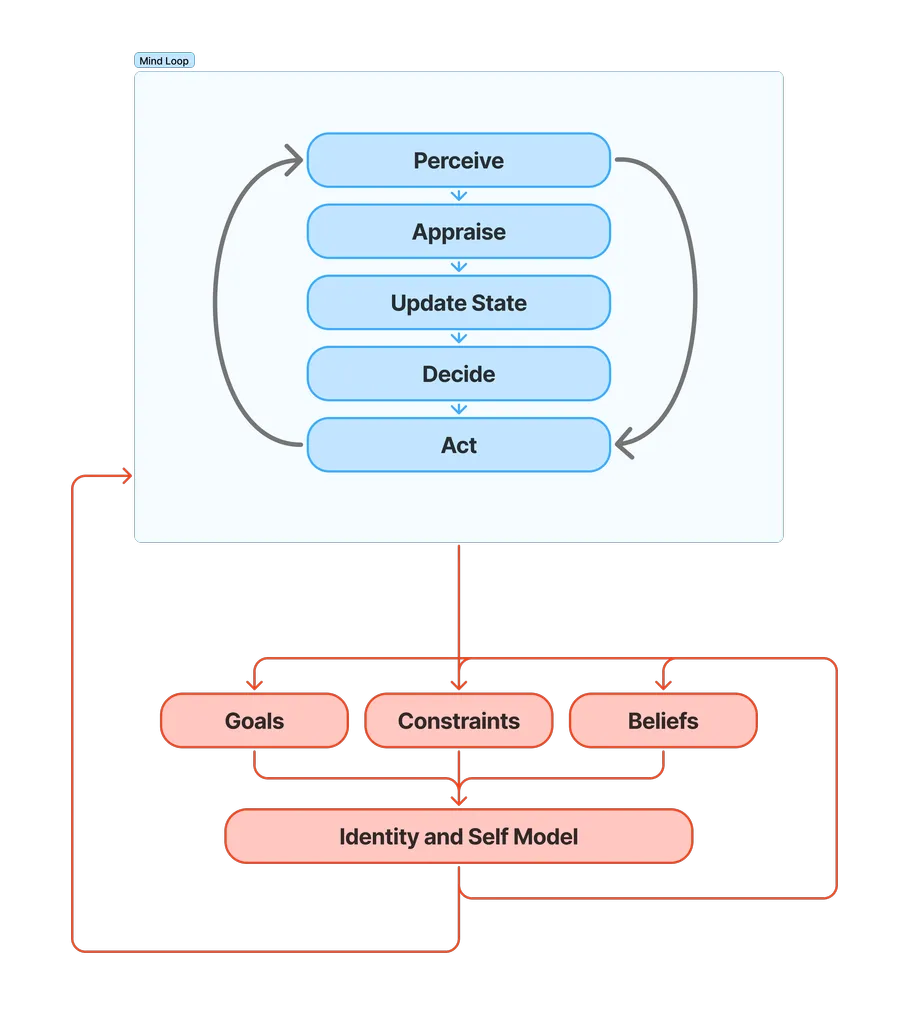
Key state components include:
Goals: short-term intentions, medium-term plans, and long-term projects/values. Goals are ranked by priority and are activated contextually, not all at once.
Constraints: time availability, financial constraints, obligations, and situational limits. These constraints are essential for realistic tradeoffs and for modelling “I want X but can’t do X.”
Beliefs with confidence: propositions stored with probabilistic confidence, source attribution, and update history. This allows belief change to be gradual and evidence-weighted rather than sudden and narrative-driven.
Affect: mood (slow-moving baseline), emotion (fast response), and arousal/energy (physiology proxy). These variables affect willingness to engage, planning depth, and interpersonal tone.
Identity and self-model: roles, values hierarchy, sacred boundaries, and narrative commitments (“I’m the kind of person who…”). This component drives stability and explains resistance to persuasion that threatens identity.
Context: time, location, activity mode, social setting, and routine phase. Context is what makes the same person respond differently on a Tuesday morning versus a Friday night.
From a statistical standpoint, structured state makes the system measurable. You can quantify within-person variance, between-person variance, and stimulus effects while holding other variables constant. You can also inspect the agent’s state as a set of covariates, enabling the same analytical logic used in real-world market research (moderation analysis, segmentation, mixed models, hierarchical regression).
Memory: episodic, semantic, procedural, working, autobiographical, and social
The system’s memory architecture is explicitly decomposed because different memory types behave differently and have different implications for behaviour. Humans do not retrieve memory as a single “queryable transcript”; they retrieve fragments that are cued, compressed, emotion-tagged, and biased by current concerns. Our design reproduces that structure in a form that remains auditable and consistent.
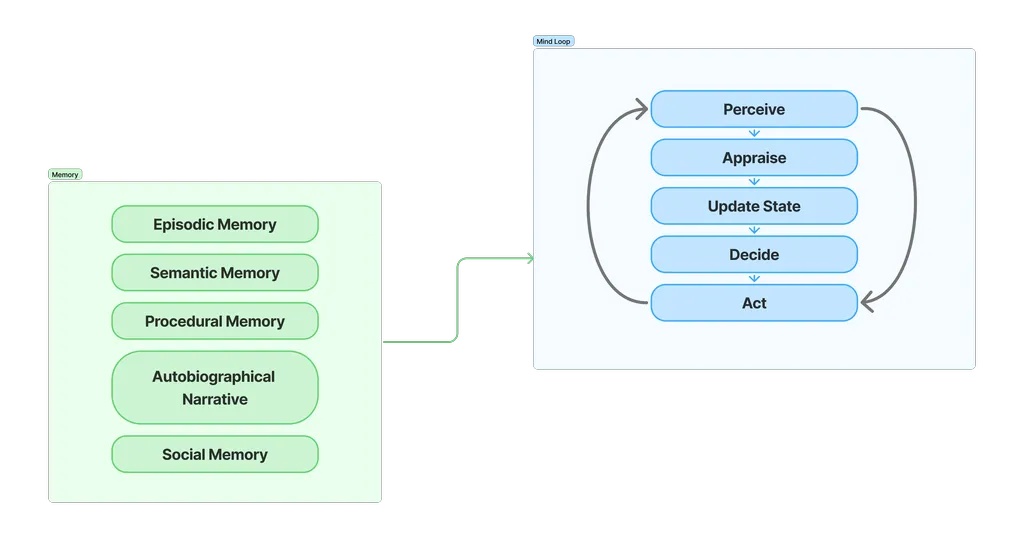
We maintain:
Episodic memory: time-stamped events with who/what/where, plus emotional tagging and salience. This is what makes a persona remember a specific bad experience with a brand, or recall a conversation, not as a full transcript but as a remembered “episode.”
Semantic memory: stable knowledge and conceptual associations—facts about the world, category knowledge, product beliefs, cultural references, and learned generalizations.
Procedural memory: skills and habits encoded as policies and routines. In consumer terms, this is how “I always buy the same detergent” persists without constant deliberation.
Working memory: a constrained scratchpad holding only the small set of currently salient items. This creates bounded rationality and realistic forgetting during complex tasks.
Autobiographical narrative: compressed summaries of “life chapters” that maintain a coherent self-story and explain stability in identity, values, and preferences.
Social memory: per-person models of others, including relationship history, inferred traits, and social expectations.
Operationally, this maps cleanly to a combination of an event log, a relational store, and a vector retrieval layer for cued recall. Most importantly, it includes forgetting (salience-based decay) and consolidation (periodic compression). Those two processes prevent perfect recall artifacts and allow the system to evolve in realistic ways.
Motivation and drives: the latent forces behind consumer choice
Human behaviour is driven by motivational systems that often operate beneath conscious articulation. In market research, this is the persistent challenge: stated attitudes are not identical to behavioural choices, and preference structures can shift as a function of stress, social context, and resource constraints. A mind simulation is only useful when it reproduces these motivational dynamics in a systematic way.
Our architecture represents drives as internal deficit/satiation variables with setpoints. Common drive families include:
security and safety
affiliation and belonging
status and respect
competence and mastery
autonomy and control
novelty and curiosity
comfort and pleasure
meaning and values coherence
caregiving and social responsibility (when relevant)
Each drive is parameterized per agent, meaning the same stimulus produces different motivational impacts across personas. Drives interact with attention (what becomes salient), planning (what options are considered), and memory (what is encoded strongly). In practical research work, this is how you get realistic heterogeneity: some agents respond strongly to price security cues, others to identity-aligned sustainability cues, others to novelty and trend signals.
Emotion: appraisal, action tendencies, and regulation
Emotion is not a decoration layer. It is a computational mechanism that changes what is processed, what is remembered, and what is chosen. A mind simulation that treats emotion as a label (“happy/sad”) without function will not reproduce realistic behavioural dynamics, especially in consumer settings where emotional associations and social identity matter.
We implement emotion as an appraisal system that maps perceived events to action tendencies. For example:
fear amplifies threat processing, increases information seeking and avoidance
anger increases confrontation, blame assignment, and certainty claims
sadness decreases exploration, increases withdrawal and reevaluation
joy increases exploration, sharing, and investment
shame increases concealment, impression management, and repair behaviours
We also implement emotion regulation strategies because humans do not passively experience emotion; they manage it. Reappraisal, suppression, distraction, problem-solving, and social soothing each have different behavioural signatures. Regulation affects response tone, willingness to engage in tasks, and the likelihood of brand switching. It is also central for modelling how consumers respond over time to repeated stressors like inflation discourse or social comparison.
Executive function: planning depth, inhibition, and cognitive control
Executive function governs how humans allocate cognitive resources. It explains why the same individual can display disciplined planning in one moment and impulsive behaviour in another. In a synthetic mind, executive function is implemented as a controller that sets budgets and constraints for cognition.
Key executive functions include:
working memory capacity management
planning depth selection (shallow under fatigue; deep under calm focus)
inhibition (preventing impulsive or socially costly actions)
error monitoring (detecting contradictions and value misalignment)
task switching costs (discouraging unrealistic rapid topic hopping)
This is also where fatigue and stress have measurable downstream effects. Under low energy or high stress load, the system relies more heavily on habits, reduces planning depth, and narrows attention. These are realistic dynamics that match observed patterns in survey effort, consumer decision shortcuts, and reduced openness to novelty under cognitive load.
Habits and procedural behaviour: the engine of routine consumption
Habit systems are essential for any model aiming to represent everyday consumer behaviour. Many purchase decisions are not re-optimized each time; they are triggered by context and executed with minimal deliberation. This is especially true in FMCG categories, subscriptions, repeat services, and daily routines.
Our habit module maintains a library of stimulus-response policies keyed by triggers such as:
time of day and routine phase
location context
mood state or stress level
social setting
specific cues (promotions, reminders, pantry state)
The system decides whether to execute a habit or invoke deliberative planning based on salience, uncertainty, drive deficits, and executive function capacity. When a habit reduces drive deficit efficiently (comfort, safety, time saving), it strengthens. When outcomes disappoint or environment changes (price increases, availability disruptions), habits weaken and deliberation increases. This mechanism is extremely valuable for market research because it reproduces path dependence: the “customer journey” is not just a series of rational steps; it is a set of routines disrupted by events.
Social cognition: theory of mind and relationship dynamics
Consumers exist inside social networks. Perceptions of brands, products, and behaviours are shaped by social comparison, norms, trust, and group identity. A mind simulation must therefore include a social cognition layer that models other people as agents with beliefs and intentions.
Our system maintains a structured representation for each relevant relationship:
inferred traits (warmth, reliability, dominance, competence)
relationship metrics (trust, closeness, resentment, dependency)
remembered interactions and turning points
predicted beliefs (“they think I’m frugal”)
conversational norms (“avoid politics”, “don’t ask for favors”)
This allows realistic interpersonal decision-making: whether an agent seeks advice, hides a purchase, shares a recommendation, or feels social pressure to conform. For market research, this is foundational for modeling word-of-mouth diffusion, household dynamics, and the social dimension of product adoption.
The cognitive operating system: orchestration, scheduling, and control
What makes the system robust is the cognitive operating system that orchestrates modules. It governs when the agent “wakes,” what it processes, and how cognitive resources are allocated. Without this orchestration layer, systems tend to degenerate into either excessive LLM calls (costly and unstable) or purely reactive chat behaviour (thin cognition).
The orchestrator controls:
circadian scheduling and daily routines
event-triggered cognition (news shock, message arrival, decision point)
selection of modules to run (appraise vs plan vs reflect)
throttling of rumination loops
triggering of consolidation cycles
budgeting of computational effort in line with executive function state
A central implementation detail is the workspace, a shared object that holds salient observations, active goals, affect state, constraints, retrieved memories, candidate actions, and the final chosen action with confidence. This blackboard structure ensures that cognition is modular and auditable, while still allowing the LLM to contribute high-quality interpretation and language generation.
Data architecture: making synthetic minds measurable, auditable, and calibratable
To support rigorous research usage, we separate stateful cognition from generated text. The system is designed so that a researcher can inspect why an answer emerged and what variables mediated the effect.
We use four primary stores:
Relational database (structured truth)
agent state, goals, constraints
beliefs with confidence and source lineage
drives and setpoints
relationships and social summaries
habits and procedural policies
plans, tasks, and outcomes
Event store (append-only)
observations ingested
actions taken
objective outcomes logged
internal state transitions (for auditing and learning)
Vector retrieval store
episodic memory embeddings
semantic memory embeddings
autobiographical narrative snapshots
This supports cue-based recall and prevents the agent from re-reading its entire history.
Artifact store
consolidated daily summaries
life chapter narratives
procedural “how I do things” skill sheets
These artifacts stabilize identity and reduce drift.
This architecture supports scientific measurement. You can run counterfactuals (“same agent, different news feed”), A/B manipulations, and sensitivity tests while keeping the memory and state trajectories consistent.
Calibration and validation: the statistical standards that make outputs credible
In market research, credibility comes from calibration, validation, and quantified uncertainty. Our system is designed to be evaluated like an instrument.
Calibration targets: matching distributions and dynamics
Calibration aligns synthetic populations with empirical reference distributions, such as:
demographic and socio-economic marginals (census, panels)
category-level behaviours (penetration, frequency, brand shares)
benchmark attitude series (consumer confidence, sentiment indices, brand trackers)
linguistic markers by segment (lexical complexity, tone, topic prevalence)
known response biases (fatigue effects, satisficing patterns, acquiescence)
Because state is explicit, calibration does not require mysterious prompt tuning alone. It can adjust parameters in drive sensitivities, attention weights, belief priors, and habit strengths, yielding more controlled and interpretable alignment.
Reliability: stability where it should be stable
A credible synthetic respondent shows:
consistent trait-level differences across time
meaningful but bounded within-person variation
predictable sensitivity to context shifts
realistic noise under fatigue and stress
These properties can be quantified using test–retest reliability, intra-class correlation, and variance component decomposition, just as in panel survey methodology.
Predictive validity: response to stimuli in correct direction and magnitude
The strongest standard is predictive: when a stimulus changes, the distribution shifts in the correct direction and approximately correct magnitude. This is where a mind simulation becomes operationally useful for forecasting messaging effects, product positioning resonance, and macro-sentiment response patterns. Because perception and beliefs are source-weighted and time-indexed, the system naturally supports backtesting: historical feeds can be replayed to evaluate whether the population’s outputs track known benchmarks.
Sleep and consolidation: how memory becomes stable knowledge
A major realism driver in longitudinal behaviour is consolidation. Humans do not store each day as an infinite transcript; they compress and abstract. Our system runs daily consolidation cycles that:
compress episodic traces into semantic summaries
strengthen emotionally salient memories
decay low-salience details
update autobiographical narrative chapters
rebalance mood baseline and stress load
This produces a stable “self” across time while preserving the possibility of change. It also prevents unrealistic perfect recall and supports the emergence of enduring brand impressions and category attitudes after repeated experiences.
Metacognition: confidence, self-monitoring, and strategy selection
Metacognition is implemented as a monitoring layer that improves both realism and reliability. It estimates confidence, detects uncertainty, and chooses cognitive strategies. In practical terms, this layer governs whether the agent:
answers immediately vs seeks additional information
hedges language when confidence is low
escalates to reflection after a salient event
avoids repeated rumination loops
notices contradictions between values and actions
This matters in research outputs. It yields more realistic expressions of uncertainty and reduces brittle responses. It also enables procedural consistency: the agent can apply stable reasoning policies rather than purely improvising.
Implementation roadmap: building the full brain system in layers
The architecture is modular and scales in capability as components are added.
Cognitive OS + structured state
workspace loop, state schema, belief confidence
retrieval, event logging, and audit trails
Motivation + habits
drive system with setpoints
habit policies, reinforcement, and disruption dynamics
fatigue effects on cognition
Social cognition
per-person relationship models
theory-of-mind inference and norm management
Emotion and regulation + metacognition
appraisal programs with action tendencies
regulation strategies and confidence estimation
Sleep and consolidation
daily memory compression
forgetting, narrative stabilization, and long-horizon coherence
This progression mirrors how human-like behaviour emerges: first continuity, then motivation, then social cognition, then self-monitoring and consolidation.
Conclusion: a measurable synthetic mind built for research-grade realism
A simulation of the human mind becomes research-grade when it is constructed as a system of interacting modules with explicit state, memory, and control. LLMs contribute language, interpretation, and planning—but the stability, auditability, and statistical credibility come from the architecture around them: multi-stream perception, attention and salience, probabilistic beliefs, drive dynamics, emotion programs, executive control, habits, social cognition, and consolidation.
For market research, this delivers something unusually valuable: synthetic participants who can be repeatedly measured under controlled manipulations, with logged mediators and interpretable drivers. The system produces realistic heterogeneity across a population and realistic variability within individuals. Most importantly, it supports calibration to empirical benchmarks and validation through predictive alignment—so outputs can be used not only as narrative insight, but as an analyzable research instrument.